Get Full Government Meeting Transcripts, Videos, & Alerts Forever!
Get email alerts on the Soft Story topic
No spam. Unsubscribe anytime.
Commission approves technical edits to soft-story bulletin and replaces 1973 benchmark date in SFBC with ASCE 41-based list
Summary
The commission unanimously approved edits to Administrative Bulletin 107 clarifying diaphragm evaluation and shear-wall connections for soft-story retrofits and agreed to a code change that replaces the single date 05/21/1973 with an itemized list of benchmark adoption years aligned to ASCE 41.
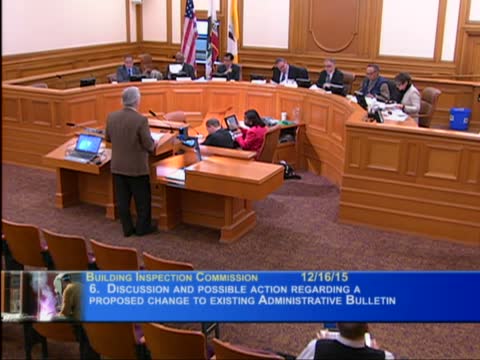
The Building Inspection Commission unanimously approved two related items Dec. 16: technical edits to Administrative Bulletin (AB) 107 for the soft-story retrofit program and a proposed code change to replace a single historical date in the San Francisco Building Code with an itemized list of benchmark adoption years.
Kirk Means (DBI Technical Services, SEG 1832) introduced language that clarifies how engineers and plan checkers should account for the attachment of shear walls to the floor diaphragm, collector elements and the contribution of existing and new sheathing. Steve Harris (chair, structural subcommittee, SEG 1851) said the bulletin language was developed through the SEANC existing-buildings committee after months of negotiation and provides reference values for diaphragm strength and acceptable approaches to supplementing existing sheathing.
Separately, staff proposed removing an arbitrary trigger date (05/21/1973) from SFBC structural-trigger language and replacing it with a table of benchmark years tied to building type and the ASCE 41 national benchmark list. The change is designed to tie structural-upgrade triggers to technical benchmarks rather than a single historical date, and would require plan-checkers to consult the new table when determining whether a proposed alteration meets the structural trigger.
Commissioners asked technical and procedural questions about when the technical provisions are triggered, how the table would be used in plan review, and the department's ability to apply the more detailed table. Staff and the consultant said the table would be codified in the SFBC, that plan checkers would refer to it in making permit determinations, and that the edits aim to reduce inconsistent interpretation across engineering offices.
There was no public opposition in the hearing; the commission voted by roll call to approve the edits and the code amendment.