Get Full Government Meeting Transcripts, Videos, & Alerts Forever!
Get email alerts on the Earthquake Early Warning topic
No spam. Unsubscribe anytime.
UC Berkeley scientist: ShakeAlert can give seconds to tens of seconds of warning, seeks Bay Area partners
Summary
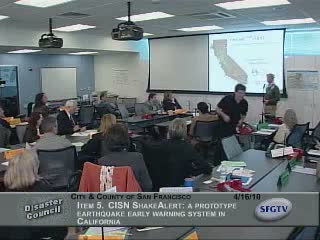
UC Berkeley seismologist Richard Allen briefed the San Francisco Disaster Council on ShakeAlert, a prototype earthquake early-warning system that provided seconds-to-tens-of-seconds alerts in a recent proof-of-concept and is seeking local partners such as BART and schools to pilot user tools.
Dr. Richard Allen, a professor at the UC Berkeley Seismological Laboratory, told the San Francisco Disaster Council that earthquake early warning can deliver seconds to tens of seconds of notice before damaging shaking arrives and that the technology is already in prototype use in California.
At the meeting Allen presented animation and event analyses showing how P waves can be detected and used to predict forthcoming S-wave shaking. He cited the Alum Rock event as a proof of concept: two stations closest to that epicenter detected the event and, within a second, the system issued a magnitude estimate (5.2) that matched the later evaluated magnitude (5.4). Allen said alert maps generated by the system were available before strong shaking reached San Francisco, yielding a few seconds of practical warning in that case.
"We're talking about a few seconds to a few tens of seconds warning," Allen said, adding that while that time is short "it can be put to great use" in automated and human responses.
The presenter emphasized limits and variability: modeled warning times depend on how far an earthquake nucleates from the city; ruptures that begin nearby fall into a "blind zone" where no warning is possible. "This is not a panacea," he said, "Not everybody will get warning for all earthquakes, but many people will get a warning for most earthquakes."
Allen reviewed international experience from Japan, Taiwan and Mexico City, saying Japan's nationwide warnings produced no reports of panic and enabled actions from schools to factories and airports. He gave an industry example in which a chip manufacturer that implemented early warning and structural changes reduced losses from $15 million to $200,000 after later temblors.
Locally, Allen described a Bay Area pilot with BART that streamed Berkeley Seismological Laboratory data to BART's operations center. In an automated future implementation, he said, the rail system could slow or stop trains automatically; the manual stop performed during a prior simulation took roughly 23 seconds, consuming much of the available warning time. "We are looking for groups to work with us as we start to roll out this early warning system," Allen said, inviting transit agencies, schools and industry to define how they want to receive information and what products would be useful.
The presentation was technical but practical in focus: Allen showed modeled maps of expected warning times (longer if rupture begins farther away; shorter if closer) and stressed the importance of combining multiple delivery methods — cell alerts, dedicated receivers, TV/radio and public address systems — to reach people and institutions.
No formal action followed; council members asked no follow-up questions during the session. The laboratory is soliciting local partners to pilot user interfaces and automated controls for critical infrastructure.
The council moved on to other agenda items after thanking Allen.