Lifetime Citizen Portal Access — AI Briefings, Alerts & Unlimited Follows
MTA outlines Transit First, Vision Zero and parking management at redevelopment workshop
Loading...
Summary
At an Oct. 6, 2015 workshop, MTA staff presented Transit First and Vision Zero policy goals and urged tying transit investments to redevelopment in areas such as Mission Bay and Hunters Point; commissioners pressed MTA on equity, tech-shuttle enforcement and resident parking policies.
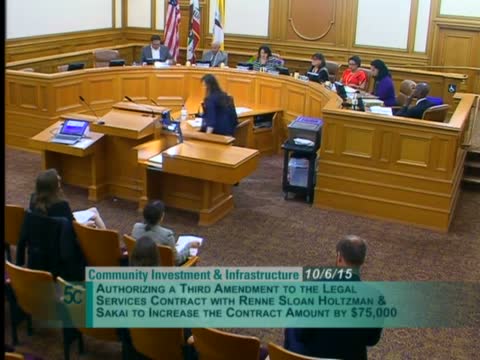
At the Commission on Community Investment and Infrastructure’s Oct. 6, 2015 meeting, Tom McGuire, director of the MTA’s sustainable streets program, told commissioners the city’s long-standing Transit First policy and the Vision Zero goal must shape redevelopment in project areas including Mission Bay, Hunters Point Shipyard and the Transbay corridor.
McGuire said Transit First — "the city's policy for over 40 years" — prioritizes public transit as the preferred mode for city trips, and described Vision Zero as a joint commitment by the mayor, Board of Supervisors and MTA to reduce traffic fatalities to zero by 2024: "Currently we lose 30 San Franciscans every year on our streets," he said. He also highlighted cost and space trade-offs in building parking, saying in San Francisco "it can cost up to a $100,000 to build a single parking space."
Why it matters: Commissioners are asked to make project-level land-use decisions that will shape how thousands of new housing units connect to transit. The MTA presentation framed parking, transit service and developer-provided transportation demand management (TDM) tools as levers to avoid gridlock and protect transit investments as the city grows.
Key points and evidence
- System goals and investments: McGuire outlined three policy pillars — Transit First, Vision Zero and a city sustainability travel target — and summarized near-term system changes including the Central Subway, Van Ness and Geary bus rapid transit projects, two-car trains on the T line when the Central Subway opens and Caltrain electrification later in the decade.
- Data and trade-offs: McGuire cited travel-distance data and argued that reducing required on-site parking helps preserve land for housing and community uses. He said the average driving trip in San Francisco is "a little less than 3 miles" and that many trips are feasible by transit, walking or biking.
- Parking management tools: MTA described both demand-management tools (pricing, real-time information via the SF Park program) and developer-side strategies (subsidized car-share or transit memberships and targeted subsidies for low-income households) as part of a toolbox to reduce circling and double parking.
Public comment and neighborhood perspective
Wendy Silvani of Mission Bay said the neighborhood has used Zipcar, car share and a shuttle program to keep drive-alone rates low, noting "our drive alone rate has been between 19–23% in the five years that we've been in business." Corinne Woods, chair of the Mission Bay Citizens Advisory Committee, said Mission Bay’s Transportation Management Plan is "very robust" but that Muni service has not always kept pace with development.
Commission questions and exchanges
Commissioners pressed MTA on several fronts: whether regional operators (BART, Caltrain) could offer deep discounts to low-income riders; how developer subsidies might be targeted; whether some redevelopment areas should avoid resident-permit parking (MTA said Mission Bay does not use resident permits); the limits of city authority over tech/commuter shuttles (regulated by the state PUC) and results from an 18‑month MTA pilot and enforcement program (McGuire said the pilot generated roughly 1,200 violations and reduced blocking of Muni). MTA staff said some solutions, such as subsidized car-share for low-income households, are possible but face practical barriers (credit cards, smartphone access) and need further design.
Quotes
"Transit First policy, which has been, the city's policy for over 40 years," Tom McGuire said, framing the agency's priorities.
"Our drive alone rate has been between 19–23% in the five years that we've been in business," Wendy Silvani said about Mission Bay's experience with multimodal programs.
Next steps
MTA staff said the workshop is an opening conversation and that project-specific transit, parking and TDM recommendations will return to the commission with neighborhood-level detail. Commissioners requested additional briefings that include regional partners (BART, Caltrain) and follow-up on enforcement and equity implications for low-income residents and seniors.
Sources: Presentation and exchanges with Tom McGuire and Sally Orth (MTA), public comment from Wendy Silvani and Corinne Woods, and commissioner questions recorded during the Oct. 6, 2015 commission meeting.