Get Full Government Meeting Transcripts, Videos, & Alerts Forever!
Get email alerts on the Mission Bay Bonds topic
No spam. Unsubscribe anytime.
OCII authorizes Mission Bay bond program, staff says refundings could save millions
Summary
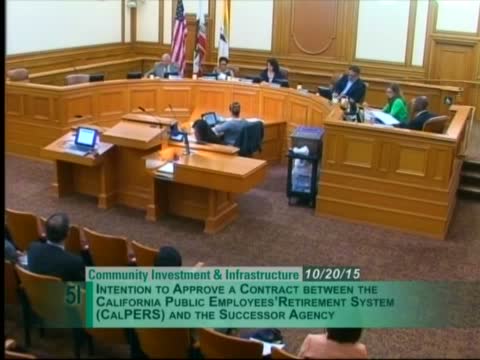
The Commission on Community Investment and Infrastructure approved a package of Mission Bay bond authorizations Oct. 20, 2015, including refunding and new-money tax allocation bonds for Mission Bay North and South, and staff told commissioners the refundings could yield multi‑million dollar savings; a public commenter urged CEQA review.
The Commission on Community Investment and Infrastructure on Oct. 20 approved a set of bond actions that will allow the successor agency to issue refunding and new‑money tax allocation bonds to support Mission Bay infrastructure and reimburse developer expenditures.
Senior financial analyst John Daigle told commissioners the package included a budget amendment to permit up to $135 million in bond proceeds (item 5C), authorization to issue Mission Bay North Series 2016A refunding bonds (not to exceed $125 million; item 5D), Mission Bay South Series 2016B refunding and Series 2016C new‑money bonds (not to exceed $115 million and $45 million respectively; item 5E), and subordinate Mission Bay South Series 2016D bonds (private placement, not to exceed $90 million; item 5F). "These bonds will provide new money for the Mission Bay South infrastructure funding, helping to maintain the pace of development," Daigle said.
Daigle said the refundings seek to take advantage of "very low market interest rates" and identified candidates: four Mission Bay North bonds (about $90 million outstanding) with total savings of approximately $21.4 million and present‑value savings of about $8.5 million, and two Mission Bay South bonds (about $80 million outstanding) with total savings of roughly $6.8 million and present‑value savings of about $6.3 million. He said staff would consider including any bond with positive net present‑value savings and recommended the Commission approve necessary authorizations and underwriter selections to proceed toward oversight‑board and Department of Finance review.
Daigle described underwriter selection: Citigroup Global Markets was recommended as managing underwriter for Series 2016A (with Baxter, McCarley & Berry LLC and Stinson Securities as co‑managers); Stifel, Nicolaus & Company was recommended for Series 2016B/2016C as managing underwriter with Baxter McCarley Berry and Blaylock Bealvan as co‑managers; and Citigroup was recommended as placement agent for the subordinate 2016D series. He said staff hopes to move to market in early January, pending oversight board and Department of Finance approvals, with a possible pricing in January and closing later that month.
Tom Lippi of the Mission Bay Alliance urged the Commission to apply the California Environmental Quality Act review, arguing that "you are approving the raising of money that will be spent to build infrastructure, which does change the physical environment," and that staff’s rationale for not applying CEQA "doesn't pass muster." Lippi said infrastructure financed through the bonds is linked to the Warriors Arena project and pointed to changes since the 1998 EIR, including a shift to a combined stormwater/wastewater system that may increase flows.
Deputy Director for Finance and Administration (recorded in the record as Grama Hoerger / Brie Mahorder) distinguished the financing decision from environmental review, saying the item before the Commission is "how will we raise the capital necessary to finance the project" and that roughly half the new‑money dollars would reimburse developer expenditures. Staff also noted that an owner participation agreement (OPA) obligates tax increment to the developer and that, in some circumstances, the agency issues debt at the developer's request.
Commissioners asked questions about tax‑exempt status, current interest‑rate assumptions (staff said new bonds would be under about 4.25% if priced that day), underwriter changes and the total outstanding tax‑increment debt. After discussion, each of the Mission Bay items (5C, 5D, 5E and 5F) was moved and approved by roll call with four ayes and one absent (Mondejar). The actions set staff to pursue oversight‑board and state Department of Finance review and to return with final documents for Commission consideration.