Get Full Government Meeting Transcripts, Videos, & Alerts Forever!
Get email alerts on the Emergency Water Transportation topic
No spam. Unsubscribe anytime.
WETA describes emergency-water transit role; agency cites funding, fuel and staffing limits
Summary
The Water Emergency Transportation Authority (WETA) told the council it was created by Senate Bill 976 to manage emergency water transport, has adopted an emergency plan, is coordinating with regional agencies, but faces funding and staffing constraints and flagged fuel resupply and docking safety as major operational challenges.
The Water Emergency Transportation Authority briefed the Disaster Council on Oct. 9 about its emergency role and recent exercises supporting maritime evacuation and recovery.
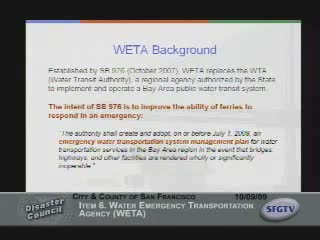
The on‑record WETA presenter described the agency's statutory creation and emergency responsibilities. "We were established by Senate Bill 976 to replace the Water Transit Authority," the presenter said, describing WETA's charge to implement an emergency water transportation system management plan and to coordinate Bay Area maritime evacuation and recovery. The agency reported adopting its draft emergency plan and taking it through stakeholder review; the WETA board adopted the plan in late June.
The presentation summarized WETA's emergency priorities: providing coordinated water transportation for passengers during emergencies, liaising with the Regional Emergency Operations Center and transportation branches (California Highway Patrol, Caltrans, Coast Guard, Metropolitan Transportation Commission) and coordinating with county operational areas including San Francisco DEM.
WETA noted resource constraints: it has a small staff (the presenter said eight staff) and limited funding as an operating agency newly transitioning from a planning role. The agency highlighted operational challenges that would affect post‑quake response, including fuel delivery (some vessels can operate about a day without refueling) and limited safe docking locations. It said it is pursuing regional fueling options and staff‑level operating procedures and conducting training and exercises with partners.
Council members pressed WETA on private‑vessel use and responder repatriation. WETA said it is concentrating on Coast Guard‑inspected passenger vessels and established ferry operators because of safety and command/control limits, although it is exploring ways to coordinate with private boat owners and the Port to create staging areas. A hospital representative raised concerns about repatriating clinical staff working in the region and the need for clear identification and prioritization of first responders boarding ferries.
WETA also described a recent full‑scale evacuation and shelter‑in‑place exercise at the Ferry Building on Aug. 19, run in coordination with BOMA and private building owners; results informed a template for evacuation and sheltering to be shared with downtown building managers and other private‑sector partners.