Get Full Government Meeting Transcripts, Videos, & Alerts Forever!
Get email alerts on the Pandemic Outreach topic
No spam. Unsubscribe anytime.
City health officials present pandemic‑flu outreach: toolkits, training kits and translated materials
Summary
The Department of Public Health described a pandemic‑flu outreach project (about 18 months long) funded mainly by an anonymous donor; materials include a public flyer (Chinese and Spanish), a business planning toolkit on CD, and a 20‑minute training kit for city employees with translated and subtitled versions.
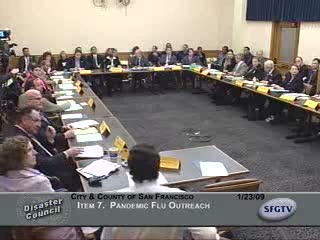
Dr. Karen Holbrook of the Department of Public Health told the Disaster Council that the city's pandemic‑flu outreach project — roughly a year and a half in development — focuses on four target audiences: the general public, businesses, city employees/disaster service workers and clinicians.
"The funding for this project I want to mention from the outset is from an anonymous donor," Dr. Holbrook said, adding that only a relatively small amount of city money went into the effort. Materials include a Pandemic Flu flyer (translated into Chinese and Spanish and posted online), a business planning toolkit delivered on CD with templates and guidance, and a training kit for city employees consisting of a 20‑minute video and trainer materials with quiz and evaluation forms.
The training kit was designed to be adaptable, Dr. Holbrook said, with chapters that allow trainers to target specific content; it is also available in Spanish, Cantonese and with English subtitles for the hearing impaired. Several agencies have begun adopting the materials for internal training, including sections of the Department of Public Health, fire‑department trainees and some local hospitals and nonprofits.
Council members asked whether the city is tracking individuals who participated in Shake Up and related activities. Dr. Holbrook clarified the program tracks agency participation rather than individual names, and that the training is not mandatory but could be incorporated into departmental performance plans if agencies choose to do so.
Health‑department staff described the Infectious Disease Emergency Response Plan and ongoing surveillance with the state and CDC as the trigger mechanism for switching from preparedness messaging to active response communications. No formal action was taken; staff said materials are available on the department website and in the meeting handouts.