Get Full Government Meeting Transcripts, Videos, & Alerts Forever!
Get email alerts on the Homeland Security Equipment topic
No spam. Unsubscribe anytime.
San Francisco showcases regional homeland-security equipment funded by UASI grants
Summary
City departments displayed regionally funded homeland-security equipment — from a PUC water-bagging trailer to fire hazmat and mass-casualty units — officials said the assets are used daily and were bought with UASI and other federal funds.
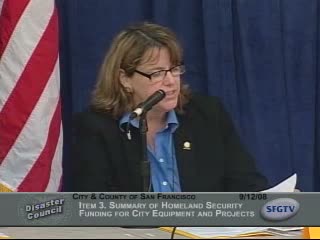
City officials on Sept. 12 presented a portfolio of homeland-security and disaster-response equipment purchased with regional UASI and other federal grants, saying the assets are integrated into daily operations and are available for large-scale incidents.
At a Pier 48 demonstration, Ed Harrington of the Public Utilities Commission described an emergency water-distribution unit that “produces 10,000 liters of potable water per day in portable, obviously, plastic recyclable plastic bags.” He said three such machines exist in the region and that the PUC is also pursuing a $4.5 billion seismic-sustainability program for the water system.
San Francisco Fire Department representatives summarized apparatus on display, including a mobile command unit purchased for about $1,000,000; a hazmat unit equipped to test samples on scene (near $400,000); a CBRN/shoring unit for collapsed-structure rescues; a mass-casualty unit the department is stocking to stabilize up to 40 patients; and a multi-casualty unit capable of supporting roughly 100 patients. Officials said many of the units were bought with earlier fiscal-year UASI funds.
Police Chief Heather Fong described police assets funded through UASI and buffer-zone grants, including explosive-detection canines (two canines cost roughly $8,000 under one grant line), a tactical trailer with self-contained breathing apparatus and protective suits, night-vision and thermal-imaging gear, an explosive-ordinance-disposal rapid-response vehicle (about $48,000) and a larger EOD command vehicle (approximately $433,000).
Other departments highlighted additional resources: the sheriff’s mobile transport and an airborne video downlink system, Department of Public Works’ communications vehicle for interoperable repeaters, and an Animal Care & Control intake/treatment tent purchased in FY2005 (about $16,000) for use as an adjunct shelter.
Officials repeatedly framed the purchases as regional assets funded through UASI and related federal programs and emphasized that most of the equipment is used in routine operations as well as reserved for large disasters. The meeting packet and staff invited attendees to inspect displays after the presentation.
The council did not take any votes on procurement at the meeting; staff said after-action reports and ongoing tests would inform future acceptance and deployment decisions.