Get Full Government Meeting Transcripts, Videos, & Alerts Forever!
Get email alerts on the Awss topic
No spam. Unsubscribe anytime.
San Francisco study flags aging Auxiliary Water Supply System, recommends $87 million in core repairs
Summary
A consultant study presented to the Disaster Council found the city’s Auxiliary Water Supply System (AWSS), built mainly in 1913, needs rehabilitation of core above-ground facilities and a pipeline optimization study; consultants estimate roughly $87 million (2008 dollars) for core repairs and urge funding discussions.
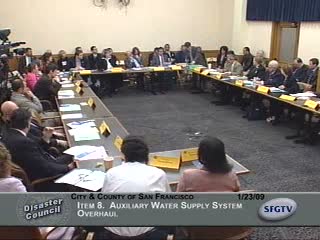
A consultant study of San Francisco’s Auxiliary Water Supply System concluded that the century‑old firefighting system needs rehabilitation of its above‑ground core facilities and a follow‑up pipeline optimization study, presenters told the Disaster Council on Feb. 2009.
"We know the system is aging. Most of it was built in 1913," said Brian Strong of the city’s Capital Planning staff, summarizing the report’s findings and seismic rationale. The study stresses AWSS’s role in supplying high‑pressure water for multi‑alarm fires and notes an estimated 62% chance of a major earthquake in the next 30 years.
The study documents AWSS components — two pump stations, two tanks, a Twin Peaks reservoir, 135 miles of large‑diameter pipe, 172 cisterns and connections for fireboats — and highlights condition problems such as settlement and corrosion at pump stations and a compromised reservoir liner. Strong presented a core‑facility rehabilitation estimate "around, $87,000,000" in 2008 dollars and recommended prioritizing above‑ground facilities because they are the system’s functional heart.
Fire Department leadership told the council they support the study. "We feel it's a wise investment in the city's infrastructure," said Chief Hayes White, who said AWSS is used regularly for higher‑alarm incidents and would be critical after a major earthquake. White acknowledged fire‑department participants in the study and urged that officials identify funding sources.
Public Utilities Commission staff emphasized that AWSS is separate from the city's drinking‑water system but said both systems are being upgraded: the potable system modernization follows a 2002 bond measure and continues alongside AWSS work.
Council members asked whether the study covered areas such as the Presidio; presenters said the Presidio was not extensively analyzed and offered to make a dedicated presentation to Presidio management. The report and its handouts were made available on the Capital Planning Program website.
Next steps described at the meeting include producing outreach to affected partners, refining an optimization analysis of the pipeline network, and identifying funding pathways to implement priority core repairs. No financing decisions were made during the meeting.