Get Full Government Meeting Transcripts, Videos, & Alerts Forever!
Get email alerts on the Emergency Response Plan topic
No spam. Unsubscribe anytime.
San Francisco outlines 24-month earthquake preparedness plan, moves emergency response plan into standalone annexes
Summary
Deputy DEM director outlined a 24-month, "stair-step" exercise and training program focused on earthquake resilience and said the city was selected for a pre-EMAP accreditation pilot while the emergency response plan is separated into detailed annexes.
San Francisco’s disaster-management leaders on Tuesday laid out a 24-month program aimed at making the city more resilient to earthquakes and announced the city has been selected to participate in a pre-accreditation pilot for the Emergency Management Accreditation Program (EMAP).
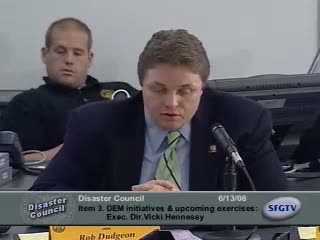
Deputy Director Rob Dodgen told the Disaster Council the department will shift from occasional, large exercises to a series of smaller, repeated events — “stair-step” tabletop, functional and regional exercises — to build and test roles across departments and private-sector partners. He said the first functional exercise is planned for July, followed by a regional exercise, Silver Sentinel, in October.
The change in approach coincides with an administrative rework of the city’s emergency operations materials. Dodgen said the city has pulled the emergency response plan out of the old omnibus Emergency Operations Plan and will publish it as the first in a set of separate, easier-to-use annexes that cover administrative, preparedness, hazard mitigation, response and recovery functions. “We’ve actually been selected as the only city to be considered as part of this pre-EMAP accreditation,” Dodgen said, describing the pilot’s role in identifying gaps and required detail.
The department emphasized practical, role-specific training: refreshers on 800 MHz radio use, exercises for EOC plan-section staff, and repeated mini-conference sessions so department staff can attend at convenient times. Dodgen said the ESF-15 public-information annex is at first-draft stage and that the emergency response plan will be posted on DEM’s website when a quick-start guide item is finalized.
City officials said the program will integrate the Unified School District and private-sector engineers, and will use lessons learned from exercises to revise plans after every event. “When our earthquake comes … it’s not if,” City Administrator Ed Lee said, urging urgency in preparedness and reiterating plans to tie exercises to regional observances such as the Hayward Fault anniversary.
The council did not take a formal vote on these items; the meeting concluded with an offer for attendees to tour the renovated Emergency Operations Center and demonstrations of new EOC technology.
Next steps: a functional exercise in July, continued annex drafting and public posting of the emergency response plan once the quick-start guide item is complete.