Get Full Government Meeting Transcripts, Videos, & Alerts Forever!
Get email alerts on the Small Business Accessibility Support topic
No spam. Unsubscribe anytime.
San Francisco details subsidized CASP inspections, loans and tenant disclosures to help small businesses meet access rules
Summary
San Francisco's Office of Small Business described a subsidized CASP inspection program, multilingual outreach, a microloan partnership and a local landlord-tenant disclosure (Chapter 38) to help small businesses understand accessibility obligations; officials reported program uptake and a wait list.
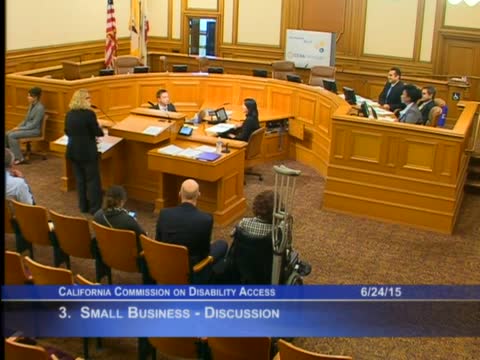
Regina Dickendresi, director of the San Francisco Office of Small Business, told the California Commission on Disability Access that San Francisco has developed a multi-pronged program to help small business owners navigate and finance accessibility improvements.
Regina said the city offers subsidized Certified Access Specialist (CASP) inspections, legal assistance and a small-loan partnership with Opportunity Fund. She told the panel that the office had conducted extensive outreach (in multiple languages) and recorded program metrics: 344 businesses have been assigned or received subsidized CASP assistance, 454 businesses applied, 36 were not eligible, and 74 are on a wait list for an inspection. Regina said six businesses had accessed the loan program and 55 had used legal services provided through the city program.
"Step 8 is ADA compliance," Regina said of San Francisco's online business portal, describing how the portal includes access considerations in step-by-step guidance for people starting a business.
Regina also outlined a local disclosure regulation, often called Chapter 38, which took effect in January 2013 and requires landlords to notify prospective small-business tenants (leases of 7,500 square feet or less) whether the property currently meets construction-related accessibility standards or whether the tenant may be liable for improvements. Regina said the city hands out multilingual brochures explaining the process and that program staff are working to reduce friction when CASP recommendations conflict with local building, historical preservation or street-use requirements.
Panelists and state representatives said financing remains a barrier. Regina said uptake of the Opportunity Fund microloan has been limited and cited an interest rate around 8 percent as one reason some businesses had not used the loan product. Jesse Torres, deputy director and small-business advocate at the governor’s GoBiz office, said the state seeks to elevate best practices and technical assistance, while Mark Quinn, District Director of the U.S. Small Business Administration, said SBA guaranteed loans can also finance accessibility improvements.
Commissioners pressed for more data on which neighborhoods and owner types used the program; Regina said early outreach prioritized Chinese, Latino and other language-specific business districts, and she offered to follow up with more statistics.
Speakers emphasized practical steps that can lower the barrier to compliance: subsidized CASP inspections, clearer landlord-tenant disclosures, workshops and trusted intermediaries (libraries, merchant associations, and SBDC networks) that can share information and reduce fear of enforcement.
The commission said it will continue to gather input from small businesses through a questionnaire and to pursue partnerships that can expand subsidies or create lower-cost financing options.