Get Full Government Meeting Transcripts, Videos, & Alerts Forever!
Get email alerts on the Land Use Development topic
No spam. Unsubscribe anytime.
San Francisco agency hears split public comment on Warriors SEIR; no action today
Summary
At a special June 30 hearing, the Commission on Community Investment and Infrastructure took public comment on the draft SEIR for an 18,500-seat Golden State Warriors arena at Mission Bay. Speakers were sharply divided: nurses and neighborhood groups warned of traffic and hospital access risks, while merchants, labor and business groups praised job and community benefits; the commission took no vote.
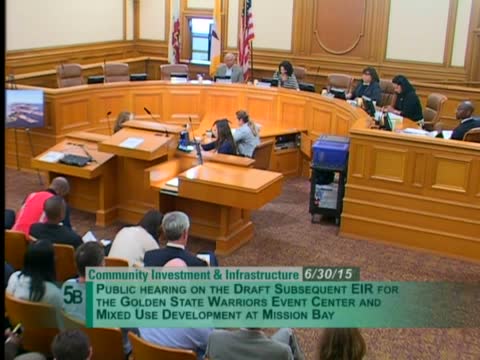
San Francisco’s Commission on Community Investment and Infrastructure on June 30 held a public hearing to receive comments on the draft subsequent environmental impact report (SEIR) for the proposed Golden State Warriors Event Center and mixed-use development at Mission Bay (Blocks 29–32). No commission action was scheduled or taken at the session; staff said the commission will consider the SEIR and responses to public comments later this fall.
The hearing opened with staff guidance from OCII Deputy Director Sally Orth, who said the draft SEIR was published June 10 and the public comment period runs through July 20, 2015; written comments may be emailed to warriorssfgov.org or submitted to the Planning Department. Orth emphasized that today’s purpose was to collect comments on the adequacy and accuracy of the environmental analysis and that staff would not respond to comments during the hearing.
Public testimony ran more than two hours and reflected a clear divide. Supporters — including neighborhood merchants, hospitality and business groups, labor organizations and event-industry firms — called the project job-creating and transit-oriented. Matt Presoff, chief operating officer of Live Nation in California, said the site is "transit rich" and that the EIR planners did a "phenomenal job" studying parking and transit options. Representatives of the San Francisco Labor Council and the San Francisco Travel Association urged the commission to move forward, citing economic benefits and the arena’s potential to attract major concerts and events.
Labor and hospitality supporters told the commission the project could create meaningful jobs for concession and service workers and boost spending at local businesses. Alejandro Madi of Unite Here Local 2 said the arena ‘‘could be a game changer’’ for food-service workers who currently hold largely part-time positions.
Opponents and healthcare workers raised public-safety and access concerns. Anna Fernandez, a pediatric emergency nurse at UCSF Mission Bay speaking for California Nurses Association members working at UCSF, said the narrow access corridors around the medical campus make timely access for patients and staff vulnerable to event-related gridlock. "What will the city do to assure the patients who need the highly specialized care that we provide will have access in a timely manner, 24 hours a day, every day, including during games and concerts?" Fernandez asked.
Speakers for the Mission Bay Alliance and other critics said the SEIR understates traffic, parking, hospital-access and local-air-quality impacts and called for more analysis and stronger mitigation. Alex Doniak of the Mission Bay Alliance submitted a petition and letters he said included more than 4,600 signatures opposing the Mission Bay location for an 18,500-seat arena.
Several speakers also questioned the fast-track review process and the adequacy of greenhouse-gas mitigation. Susan Vaughn of the Sierra Club (speaking for herself in the hearing) said she was concerned that a legislative fast-track provision (referred to in the transcript as "AB 9,900") reduced public review opportunities and that proposed carbon offsets lacked sufficient specificity. A Mission Bay Alliance representative criticized purchasing unverified offsets as inadequate to address localized air-pollution and access concerns.
Business and neighborhood supporters countered that the project includes transit and traffic-management plans intended to prioritize transit, bicycle and pedestrian access; speakers noted planned bike lanes, extensive bike parking, and proposed transit service improvements. Several speakers pointed to prior large-event management in San Francisco (including AT&T Park) as precedent for effective traffic mitigation.
The hearing included a mix of neighborhood voices: residents who said they expect the area to grow and welcomed the arena’s parks and retail; merchants and nightlife representatives who forecast economic benefits; and residents and workers near UCSF and the proposed site who urged stronger guarantees for emergency access and parking management.
The commission did not act on the project. Chair Rosales closed the public comment period, reminded attendees that the draft SEIR’s written-comment deadline is July 20, 2015, and staff said all comments and staff responses will be compiled in a responses-to-comment document to be brought back to the commission later this fall.
A separate consent-item vote earlier in the meeting approved minutes for a prior meeting by roll call (2 ayes, 1 abstention, 1 absent).