Get Full Government Meeting Transcripts, Videos, & Alerts Forever!
Get email alerts on the Housing Marketing topic
No spam. Unsubscribe anytime.
OCII and MOHCD outline marketing changes, COP outreach and new centralized application plan
Summary
OCII staff and the Mayor's Office of Housing and Community Development described new early-outreach marketing requirements for developers, data and outreach results for the Certificate of Preference program, and a planned database (DALIA) to centralize affordable-housing listings and applications.
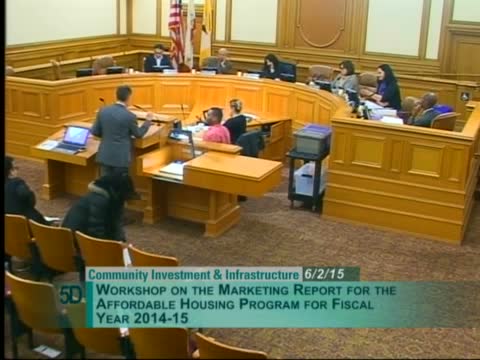
The Commission on Community Investment and Infrastructure on June 2 heard a workshop on marketing and outreach for OCII-affiliated affordable housing and a status update on the city's Certificate of Preference (COP) program.
Maria Benjamin of the Mayor's Office of Housing and Community Development told the commission that developers must submit a marketing-plan template early in construction and begin targeted "early outreach" roughly 15–18 months before units come online. The template requires developers to disclose unit mix, the affordable units in each building, specific occupancy preferences, eligibility criteria and an appeals/grievance process.
Why it matters: OCII-affiliated developments rely on developers to reach targeted and underserved populations. Commissioners pressed staff to ensure outreach reaches displaced residents and other priority groups, and to resolve conflicts between local preference goals and external funding restrictions.
COP program and outreach: Benjamin presented data for recent projects and said the agency has re-established contact with previously unreachable COP holders. Key figures cited: 6,609 COP certificates have been issued historically for active project areas (Western Addition and Hunters Point); 1,660 certificates have been used to house people; 519 certificates remain issued but not yet used; and a recent contractor search located 1,164 new addresses staff is contacting. On the 1180 Fourth Street project, she said 149 units were offered (50 units for formerly homeless households and 99 low-income units), with 2,983 total lottery participants, 13 COP applicants and three COP holders actually housed at that development; others were disqualified for reasons including over-income status, no-shows, withdrawal or being housed elsewhere.
State/federal funding constraints: Commissioners asked why some COP applicants were disqualified on the basis of being "over income." Staff explained that many rental projects use funding sources (federal low-income housing tax credits, state and other funds) that set strict income limits tied to area median income (AMI); those funding rules sometimes make local preference infeasible for specific developments. Maria Benjamin and OCII staff said they negotiate marketing and tenant-selection policies where possible and that the agency approves every outreach flyer before distribution.
DALIA, fair-chance policy and partnerships: Benjamin described DALIA (Database of Affordable Listings, Information and Applications) as a platform in development that will allow applicants to create an account, save application data and apply across multiple developments. She also said OCII and MOHCD are implementing San Francisco's Fair Chance Ordinance in marketing and selection (limits on criminal-history screening) and cited a new partnership with the San Francisco AIDS Housing Alliance to provide rental subsidies for some senior and disabled households.
Commissioner concerns and next steps: Commissioners urged more active surveying of COP holders to determine who wants housing now, discussion of neighborhood-preference feasibility, and outreach to underserved groups using non-digital channels (Spanish radio, churches) to improve demographic reach. Staff said they will continue to refine outreach, report back on the 1,164 newly located COP addresses and pursue a limited extension of certain COP program deadlines for active project areas.
What's next: Staff will incorporate the presentation into an OCII annual housing report and expects to return with implementation updates and results from the new DALIA pilot in the fall.