Get Full Government Meeting Transcripts, Videos, & Alerts Forever!
Get email alerts on the Volunteer Management topic
No spam. Unsubscribe anytime.
San Francisco unveils HelpBayArea portal to register volunteers and 32,000 employees
Summary
City officials demonstrated helpbayarea.org, a regional volunteer and employee management system that can register volunteers now and will integrate roughly 32,000 San Francisco city and county employees for emergency deployments, rostering and mass notifications.
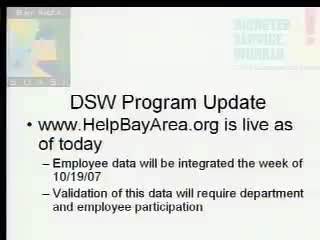
San Francisco officials demonstrated a new regional volunteer and employee management system, helpbayarea.org, telling the Disaster Council the portal is live for volunteers and will soon be populated with city employee data to speed emergency response.
William Bass, the presenter for the Disaster Service Worker program, showed the live training site and said volunteers could "register right now." He described the system as a searchable regional "portal for our regional employee and volunteer management system," with roughly 150 specialized search fields for skills, languages and credentials. Bass said the system will let staff create missions, deploy personnel and generate rosters from affirmative responses.
Bass said PeopleSoft will remain the city's system of record and the Help Bay Area system will import PeopleSoft data; employees will need to update PeopleSoft if their contact information is incorrect because there is no two‑way write link between the systems. He told the council San Francisco will be the first municipality to load its full employee roster into the platform and estimated the city will add "all 32,000 of our employees in this system." He also highlighted a pilot to use ID‑card scanning and automated time‑and‑attendance tracking to prefill reimbursement forms for volunteer hours.
The portal includes an integrated communications engine that can send internal messages, email, pager, text or phone calls with text‑to‑speech prompts. "Right now, we have a capacity of about 2,000 calls per hour," Bass said; "that would ramp up to about 20,000 calls per hour" when combined with the state's capacity via the vendor contract. He emphasized that the vendor's data centers are hosted outside California to improve resilience if a local disaster affects state infrastructure.
Council members asked how the system will incorporate nonprofit and clinic staff. Bass said contracted service providers can be added as groups in the system and recommended using contracting language to direct partner organizations to register staff; he also said the community hub planning process will fold many contract partners into the city's approach. He described an expedited field registration process and paper intake forms for spontaneous volunteers when power or connectivity is disrupted.
Officials said next steps include integrating employee data into the portal and conducting a citywide recall exercise to test data integrity and messaging workflows. The council praised the system's regional interoperability potential and asked staff to firm up strategies to incorporate nonprofit workforces and to run pilot tests.
The city will continue validating PeopleSoft imports and coordinating with regional partners on a phased rollout to Bay Area counties.