Get Full Government Meeting Transcripts, Videos, & Alerts Forever!
Get email alerts on the Emergency Operations Plan topic
No spam. Unsubscribe anytime.
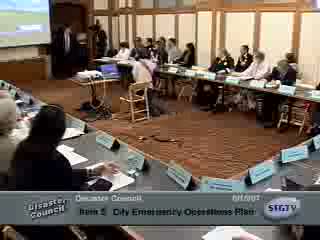
Disaster council reviews EOP revisions, tsunami-readiness work and public concerns about emergency staffing
Summary
Council members reviewed an incremental Emergency Operations Plan rewrite and tabletop exercise, approved an administrative after-action report on the Broadway rock slide, heard tsunami-signage plans for Ocean Beach, and answered public concern that many key responders live outside San Francisco.
The San Francisco Disaster Council on Monday received a progress update on an incremental revision of the city's Emergency Operations Plan and fielded public worry about whether key responders would reach the emergency operations center after a major incident.
Rob Dudgeon (named by the chair) described the EOP revision process, which began in January, and said the team has drafted a concept of operations to clarify information flows among department operating centers, incident command posts and the emergency operations center. "We're to that point where the concept of operations has been fleshed out," Dudgeon said, and staff will test the concept in a tabletop workshop next week before producing annexes and incident-specific plans.
Council members also received the administratively required after-action report on the Broadway rock slide of Feb. 27, 2007. Vicky (Speaker 4) said a summary and a revised building-status update from the Department of Building Inspection were provided for review and that no action was required under the administrative code.
On tsunami readiness, Vicky said signs marking inundation zones and evacuation routes along Ocean Beach will begin going up next week and that outreach through the Mayor's Office of Neighborhood Services will continue. "This will culminate with a major kickoff in August," she said, and staff described the work as part of preparing for National Weather Service tsunami-ready certification.
During public comment, Aristide, a volunteer, urged planners to explain how the city will get police, fire and nurses back to the EOC if bridges and roads are impassable. "All the key personnel... live elsewhere. How do you plan to handle this emergency room? People will be dying in the streets by the thousands because nobody is here," Aristide said, citing lessons from the 1989 earthquake.
City officials acknowledged the problem and described a combination of recall protocols, updated contact lists, agreements with water transit and port agencies, and incentives being negotiated in an MOU to encourage police to live in San Francisco. Officials also cited a regional personnel and volunteer-management system that could communicate with large numbers of volunteers and noted the city has about 14,500 trained NERT volunteers.
Why it matters: Council members said the EOP revisions, exercises and neighborhood outreach are intended to make response procedures clearer and more usable during a real incident. Public commenters pushed the council to address workforce availability and housing incentives as a preparedness priority.
Next steps: Staff plans a tabletop exercise next week to test the draft concept of operations, circulation of sections for comment in the coming weeks, and a final draft expected after the summer exercises with an anticipated September 'bridal' copy for review.