Get Full Government Meeting Transcripts, Videos, & Alerts Forever!
Get email alerts on the Disaster Training topic
No spam. Unsubscribe anytime.
San Francisco unveils citywide disaster service worker training and regional volunteer system
Summary
City staff presented a new Disaster Service Worker (DSW) training rollout, a Bay Area volunteer management system covering 10 counties and an ID‑card program that will issue color‑coded access cards to about 27,000 employees; training will be tracked in PeopleSoft and delivered in multiple formats.
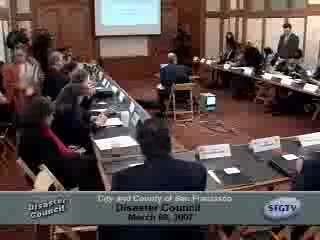
William Bass, identified in the record as the presenter, described a citywide rollout of Disaster Service Worker training and a Bay Area volunteer management system the city plans to use to screen, recruit and deploy volunteers and employees during emergencies. "We're gonna be using, for all 10 counties in the Bay Area, a single system to screen, recruit, manage, deploy, and communicate with all volunteers in the Bay Area," Bass said during the council presentation. The program materials and a video are available at sfdsw.org, which Bass said is live and featured on the city's front page.
The training package includes three delivery modes: a web‑based module that tracks progression and quizzes, a classroom PowerPoint, and a video stream. Bass said the web module integrates with PeopleSoft so the city can generate reports and certificates of completion; he said the goal is for employees to cycle through the training on about a two‑year refresh schedule. "We've set up PeopleSoft, the citywide human resources system, so that on a two year anniversary we can generate reports and show which ... employees have and haven't taken the training," he said.
The program also includes color‑coded disaster service worker ID cards that indicate access levels. Bass said the city intends to issue cards to roughly 27,000 employees, with issuance of public‑safety (red and yellow) cards to be completed within four to five months. He emphasized personal preparedness for employees — including a household go bag and a reunification plan — so workers can perform DSW duties without worrying about family or pets.
The presentation acknowledged operational challenges: some employees lack electronic access, so multiple modes of training and printed materials will be used; about 5,000 employees currently do not receive pay by direct deposit, which staff said could complicate post‑disaster payroll if non‑electronic checks are disrupted. Bass and other staff urged departments and HR representatives to help employees enroll in direct deposit where feasible and to use the provided checklists and departmental inserts in the presentation folder.
Next steps outlined to the council included HR guidance on entering completion records, targeted department rollouts (the Port of San Francisco was identified as an early test site), and continued coordination with department disaster coordinators to tailor implementation.