Get Full Government Meeting Transcripts, Videos, & Alerts Forever!
Get email alerts on the Budget topic
No spam. Unsubscribe anytime.
SFUSD board files negative fiscal certification, authorizes early-retirement offer and fiscal-stabilization plan
Summary
The San Francisco Board of Education voted to file a negative first-interim fiscal certification, approved a supplemental early-retirement program (SERP) authorization and advanced a fiscal-stabilization package aimed at closing a projected structural deficit. Staff projected a multi‑year cash decline and said final reduction details will be firmed up in February.
The San Francisco Board of Education voted to file a negative first-interim fiscal certification and approved a package of measures to address a multi-year structural budget shortfall.
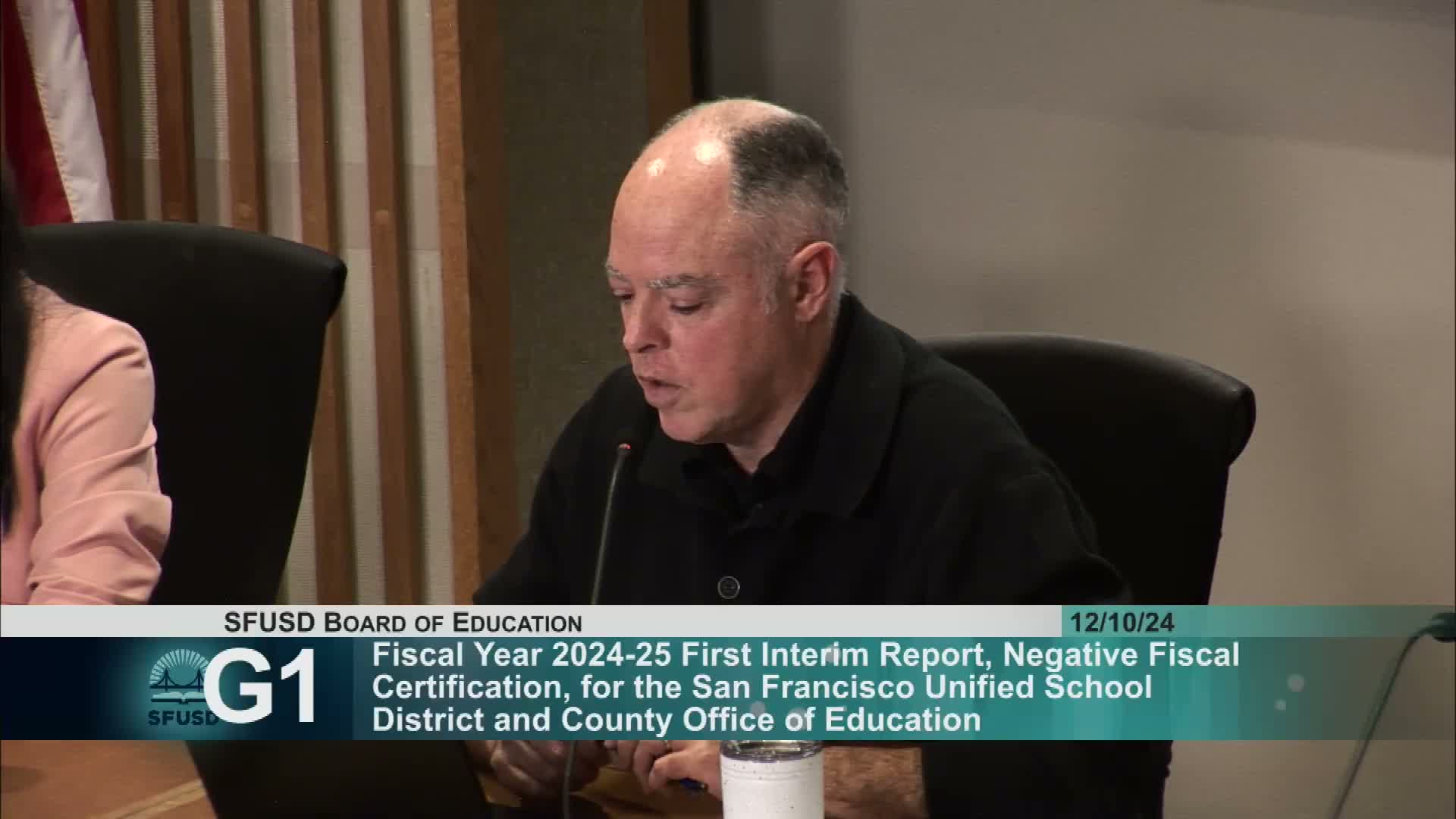
Superintendent Hsu and finance staff presented the first interim report, saying the district faces deficit spending in 2024–25 and beyond. Roseanne Lazcano, interim chief business officer, told the board staff projected unrestricted deficit spending of approximately $110,000,000 for 2024–25 and $127,900,000 for 2025–26 and described a cash‑flow projection that shrinks the district—s cash position from about $540,000,000 at the end of 2023–24 to roughly $80,000,000 in later projection years without corrective action. “Cash is king,” a district fiscal advisor told the board as staff outlined the risk of running short on operating cash in late 2026 if no changes are made.
The board approved three related action items by roll call: the negative fiscal certification (G1), authorization to offer a supplemental early-retirement program (SERP) (G2), and an updated fiscal-stabilization plan (G3). President Alexander called each vote; all three measures passed on 6–0 recorded roll calls.
The stabilization plan staff presented relies on three main levers: contract and nonpersonnel reductions, a SERP to incentivize voluntary separations, and, if needed, targeted layoffs. Staff said the plan aims to reduce roughly $113,000,000 in 2025–26 and additional amounts in subsequent years to restore structural balance. A SERP vendor presentation described an enrollment model that estimated about 1,372 eligible employees and outlined break-even participation thresholds; the vendor said the district would pay costs over a five-year annuity only if participation met those thresholds.
Board members pressed for clearer site-level staffing projections and a stronger link between reductions and the board—s goals and guardrails. Several commissioners emphasized that any staffing-model changes must account for schools— unique student populations and special‑education needs. Staff said they expect more detailed reduction schedules and site staffing allocations by February, before statutory March 15 notices would be required for certificated staff if reductions proceed.
The board also adopted related votes that evening including appointments to advisory bodies and routine consent items. The board approved the consent calendar and an agreement to allow donated logo installations at Bret Hart Gym as presented by staff under board policy 1325.
The district plans additional public engagement and acknowledged further audits and reviews (including an FCMAT special-education review) to inform final budget decisions. The board—s actions set a timeline for staff to return with more specific allocation and layoff scenarios in the coming months.