Get Full Government Meeting Transcripts, Videos, & Alerts Forever!
Get email alerts on the Article 38 Ventilation topic
No spam. Unsubscribe anytime.
Building Inspection Commission backs sending corridor-ventilation study for advisory review
Summary
The Commission voted unanimously June 17 to send an engineering report assessing a corridor-as-plenum ventilation alternative for DPH Article 38 to the code advisory/AB005 review process, with staff saying any proposal would require case-by-case equivalency approval and additional safety mitigations.
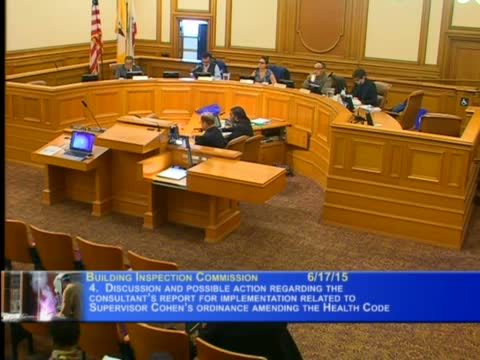
The San Francisco Building Inspection Commission on June 17 voted unanimously to put on record its support for sending an engineering study of a corridor-as-plenum ventilation approach for Department of Public Health Article 38 projects to the code advisory (AAB) and local equivalency review.
The report, presented by consultant David Rich, analyzed the corridor‑ventilation design’s fire‑safety implications and concluded the approach ‘‘is safe’’ when paired with targeted mitigations. Rich said the system relies on two primary components — pressurized quarters and protected openings equipped with fire/smoke dampers — and that egress timing for occupants can be longer than expected, ‘‘about 13 minutes’’ under standard assumptions. He warned that if a fire‑damper in the room of fire origin fails, ‘‘smoke will enter the corridor’’ and that risk must be offset by enhanced inspection, testing and maintenance and by considering upgrades to smoke detection and the fire‑alarm linkage.
DBI mechanical supervisor James Zahn told the commission that, because the state building code ‘‘clearly indicates that the corridor is not allowed to convey the outside air,’’ any applicant proposing a corridor‑plenum design would have to pursue a local equivalency process (AB 005) and that approval would likely be considered on a job‑by‑job basis. Zahn recommended forming an ad‑hoc working group of mechanical and fire‑prevention experts to develop the administrative and technical processes needed to implement any alternative.
Commissioners questioned whether the recommended mitigations should be completed before allowing projects to use the alternative. Rich said the recommendations are intended to be packaged into follow‑on amendments or administrative bulletins and incorporated as part of the equivalency review rather than as a retroactive fix.
Commissioner Walker moved that the commission be ‘‘on record supporting this into the next phase of discussion’’ and send the report to the advisory review; the motion carried unanimously on a roll‑call vote.
The vote does not change the state building code; DBI staff said the corridor‑as‑plenum path is a performance‑based alternative that would require local equivalency review, additional technical documentation, and likely enhanced inspection and alarm linkage requirements before any project could rely on it.
Next steps reported to the commission included convening the ad‑hoc technical group and drafting administrative guidance for AB 005 review. The commission took no public comment on the item.