Get Full Government Meeting Transcripts, Videos, & Alerts Forever!
Get email alerts on the Fee Study topic
No spam. Unsubscribe anytime.
BIC approves revised DBI fee tables after Controller's fee study recommending permanent 7% reduction and new high-end tiers
Summary
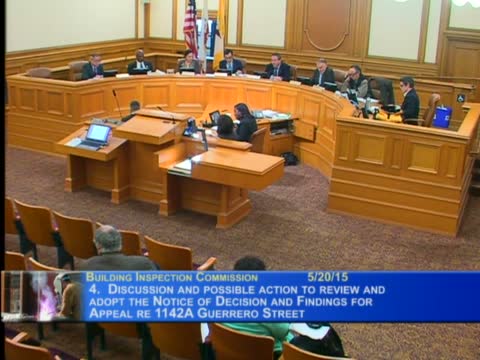
Following a Controller's Office presentation, the Building Inspection Commission adopted revisions to DBI—s building permit fee tables — including making the 7% reduction permanent, adding valuation tiers for large projects, and eliminating a technology surcharge — intended to draw down a multi‑year fund surplus. The motion passed 6–1.
The Building Inspection Commission on May 20 voted to adopt revisions to the Department of Building Inspection—s fee tables after hearing a presentation from the Controller—s Office that recommended changes to reduce an accumulated fund surplus.
Randy McClure, project manager in the Controller—s Office, told commissioners the department—s revenue has climbed from about $41.5 million in 2009 to roughly $77.8 million in 2014, with a projection near $79 million for 2015. That growth created a multi‑year surplus that peaked near $27 million; the controller—s study recommended steps to draw that down responsibly while preserving departmental capacity.
Key recommendations presented and adopted as part of the package were: - Make the existing 7% reduction in many fees permanent (estimated annual revenue impact: about $3.3 million based on FY14 volumes). - Add four valuation-based tiers at the high end of building and plan-review fees (5–50M, 50–100M, 100–200M, 200M+) to better account for economies of scale among large projects (estimated effect: $6–7 million/year). - Eliminate a 2% technology surcharge on permits (estimated effect: $1.8–2.0 million/year) rather than continuing it as a separate revenue source.
Taken together, staff estimated the combined near-term revenue reduction and proposed increased spending would move the fund balance toward a target four-month operating reserve by about FY2018. The Controller—s Office also recommended setting aside $31.6 million of the fund for Other Post Employment Benefits (OPEB) liabilities as a one-time allocation.
Commissioners pressed staff on methodology and policy implications: how the study measures cost of service (salaries, benefits and department costs were included), whether permit valuation treats public and private projects differently (the consultant did not distinguish; fee tables remain uniform), how vacancies and hiring plan assumptions affect projections, and the mechanics for revisiting fees if conditions change. Deputy City Attorney Marlena Burn clarified that city fees must be cost‑recovery based and cannot be used as a general subsidy or cumulative offset for unrelated services.
After discussion, a commissioner moved to adopt the revised fee tables (which included correcting an apartment-license line item that should not be reduced). The motion was seconded. Following the roll call, the motion carried 6–1 (Commissioner Walker dissenting). The commission directed staff to move the amendments forward to be considered as a rider to the next fiscal year budget and to work with the City Attorney—s Office to meet the June 1 deadline for budget submittal.