Get Full Government Meeting Transcripts, Videos, & Alerts Forever!
Get email alerts on the Candlestick Demolition topic
No spam. Unsubscribe anytime.
Residents press DBI, Health Department and air regulators over missing dust and asbestos monitors at Candlestick demolition
Summary
Residents and community groups told the Building Inspection Commission they cannot find monitors listed in reports, allege unsigned independent evaluator checklists and asked that the city require third‑party verification; DBI said inspectors visit daily and DPH committed to convene an interagency task force to verify monitor placement and reporting.
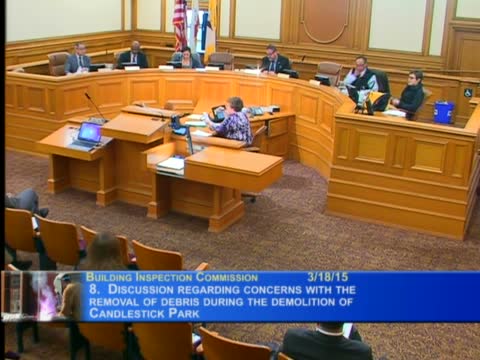
San Francisco residents and public‑health advocates told the Building Inspection Commission on March 18 that particulate and asbestos monitoring at the Candlestick Park demolition site is incomplete, inconsistently installed and not transparently reported, and they asked the commission to use permitting authority to ensure proper monitoring and enforcement.
Shirley Moore of the Clean Air Initiative and the Candlestick Point Neighborhood Committee said community members are worried that high‑reach excavation will send dust into nearby neighborhoods and that residents lack access to accurate monitor data. Andrew Graff of Golden Gate University’s Environmental Law and Justice Clinic said public‑records requests returned independent evaluator checklists that were unsigned and lacking sufficient detail to verify chain of custody.
"None of those checklists were signed, and they didn't have enough information," Graff told the commission. He asked DBI to use the dust control plan incorporated into the demolition permit to enforce reporting requirements and to independently evaluate compliance.
Dr. Ray Tompkins and other community scientists said some monitors listed in contractor or agency reports could not be located on site, that certain instruments appeared to lack proper filters or were placed where airflow is reduced, and that the community needs both particulate and asbestos sampling at seven locations plus third‑party verification.
Deputy Director Dan Lowry (DBI) said DBI has a district inspector on site daily since February and that inspectors have documented watering and the contractor's sequence of operations. He explained that Bay Area Air Quality Management District (BAAQMD) operates the air monitors and that the Department of Public Health (DPH) coordinates monitoring and complaints. "If the dust control plan is not being properly followed, the health department will notify us and we will investigate and can issue a notice of violation," Lowry said.
Karen Cohen from DPH's Environmental Health said DPH approved the dust control plan for the large site and acknowledged community concerns about incomplete or unsigned reports. Cohen committed to convene an interagency group (DPH, DBI and BAAQMD) and to follow up with the commission next week with more specific information about reports and contact points.
Commissioners pressed for: a publicly available map of monitor locations, signed independent evaluator reports, immediate verification that monitors are functioning and a mechanism to suspend the demolition permit if monitoring and documentation are not provided. Several commissioners said DBI can use its permit enforcement authority if downstream agencies confirm monitoring failures.
What's next: DPH said it will convene agency partners and provide follow‑up to DBI and the commission within a week; commissioners asked staff to return the item next month with a written update and possible action options.
Representative quotes from the hearing are limited to speakers identified in the meeting record; for reports and technical data the community provided a package to the commission during the meeting.