Get Full Government Meeting Transcripts, Videos, & Alerts Forever!
Get email alerts on the Noise Ordinance topic
No spam. Unsubscribe anytime.
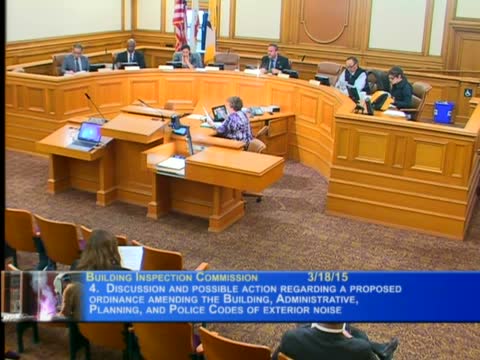
Building Inspection Commission backs city ordinance to require noise disclosure and early review near nightlife venues
Summary
The commission voted unanimously March 18 to recommend Board of Supervisors file 141,298, which would require developers to notify nearby entertainment venues, give the Entertainment Commission a chance to review projects within 300 feet, and require sellers/landlords to disclose proximity to permitted venues to buyers and tenants.
The San Francisco Building Inspection Commission voted March 18 to recommend support for a proposed ordinance (Board file 141,298) that would require notification, acoustical analysis and disclosure when new residential projects are proposed near permitted entertainment venues.
Connor Johnston, legislative aide to Board President London Breed, told the commission the ordinance aims to help long‑running nightlife venues coexist with new housing. Johnston said planning will notify a venue when a project is proposed within 300 feet, the Entertainment Commission may hold a hearing to discuss coexistence measures, and sellers or landlords must disclose the presence of a nearby venue to prospective buyers or tenants.
“The goal is to start the conversation early between these residences and the venues nearby,” Johnston said, adding that the measure also prevents a venue from being declared a nuisance where it is operating within the terms of its permit.
The ordinance incorporates sound‑level language taken from state code and local building code sections (building codes 12074 through 12079) specifying allowable interior sound levels and field‑testing standards, Johnston said. He also said the Entertainment Commission would provide recommendations on mitigation such as thicker windows or ventilation but would not issue building approvals.
Commissioners welcomed the intent but pressed for clarity on enforcement and appeal rights. Commissioner Walker asked whether existing buildings and older neighborhoods would be covered; Johnston said the latest version broadens the non‑nuisance protection to buildings constructed after Jan. 1, 2005, to reflect modern standards. Commissioner McCarthy and others said they supported the effort to avoid the pattern of complaints and venue closures sometimes triggered when residents move into areas near established nightlife.
Jocelyn Kane, executive director of the Entertainment Commission, called the measure “an early start” for conversations between developers and venues and said her commission’s role is advisory: “These are recommendations only. The law is the law, the planning department and your commission have the rights and responsibilities to continue to have.”
After discussion, an unidentified commissioner moved to recommend the ordinance and another commissioner seconded. The motion passed unanimously: President McCarthy, Vice President Marr, Commissioner Gray McCray, Commissioner Melgar and Commissioner Walker all voted yes.
What happens next: the commission’s recommendation goes with the ordinance as it continues through the Board of Supervisors and relevant city agencies. The commission asked staff to provide follow‑up if clarifications are needed about technical standards or implementation procedures.
Authorities referenced in the discussion include the Board file number 141,298 and building code language cited by staff (building codes 12074–12079).