Get Full Government Meeting Transcripts, Videos, & Alerts Forever!
Get email alerts on the Literacy And Education Outcomes topic
No spam. Unsubscribe anytime.
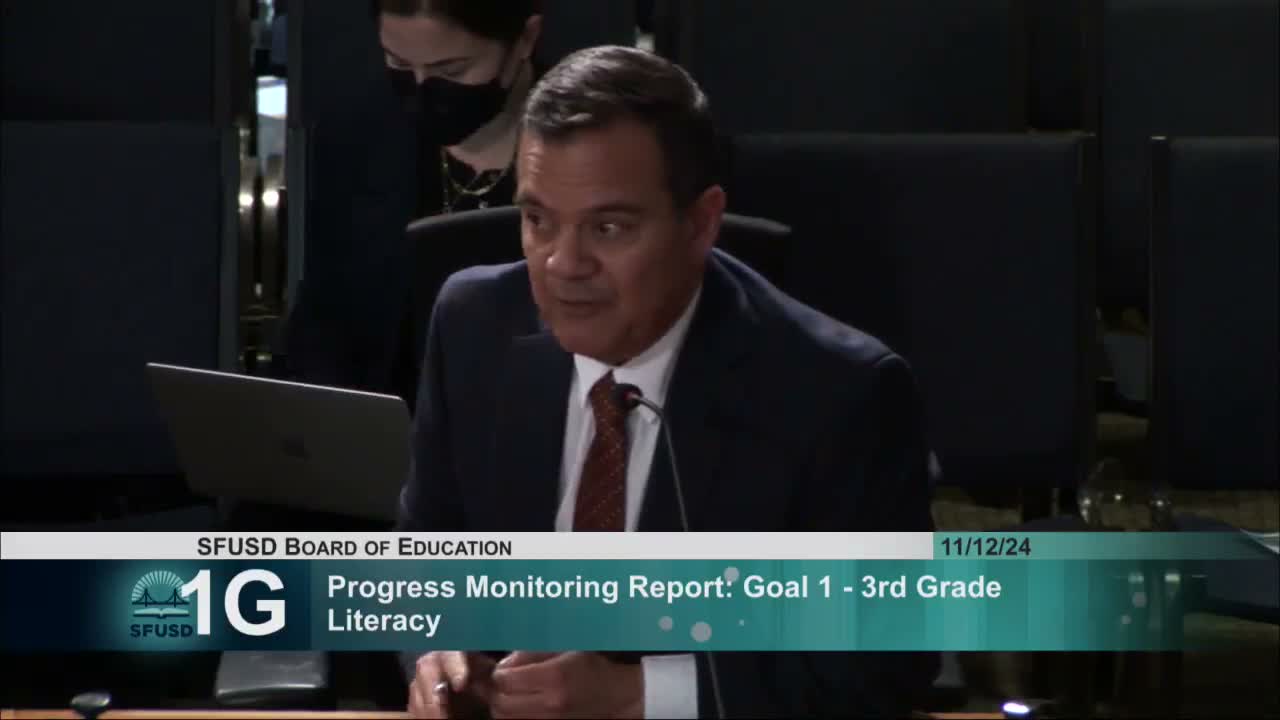
Board hears third‑grade literacy progress report; staff point to implementation steps as union and parents press for clearer data and intervention funding
Summary
District staff reported a 49% grade‑three STAR proficiency rate and said the interim target will remain at 55% for the year while the long‑term goal is 70% by 2027. Teachers, parent groups and United Educators (UESF) urged clearer disaggregated data, protections for multilingual learners, and funding for tier‑2 interventions (RTIF/ARTIF); the union criticized central office contracting and asked the board to prioritize site funding.
District staff presented the progress‑monitoring report for third‑grade literacy and fielded an extended question‑and‑answer session with board members after community testimony pressed for accountability and intervention funding.
Deputy Superintendent Kathleen Aguilera Ford summarized STAR assessment results and said the district’s grade‑3 proficiency rate in the latest window is 49%, short of the interim target. "We did not meet the goal that we targeted...the current school year target has been adjusted slightly to 55%," she said, while restating the district's longer‑term aim of 70% proficiency by 2027.
Staff highlighted bright spots: almost a nine‑percentage‑point increase for some African American and Pacific Islander kindergarten cohorts and a small number of schools that showed strong gains transitioning from second to third grade (Webster and others were named as examples). A panel from Dolores Huerta Elementary — Principal Edward Garnica, instructional coach Anna Maria Oliver and kindergarten teacher Georgina Cruz Martinez — described community‑driven implementation, coaching networks, co‑teaching and attention to phonics as contributing factors.
But public commenters and board members pressed for more and clearer data. Community members and advocates asked for disaggregated results for focal populations (English learners, students with IEPs, tier‑2 and tier‑3 groups), and for more transparency about implementation fidelity and tier‑2 dosage. "We have no progress monitoring data for all the focal groups," said a caller who identified themselves as working on literacy monitoring in the district.
United Educators of San Francisco (UESF) executive vice president Frank Lotte addressed the board during public comment earlier in the meeting and accused the central office of "mismanagement," citing a previously presented $130 million surplus, a $60 million stabilization agreement and substantial contracting out that he said replaced union positions and diverted resources from school sites. "We cannot sit idly by as another school is disrupted by this mismanagement," Lotte said, urging audits and a focus on site funding rather than contractors.
During the board’s Q&A, members asked staff to explain why gains in kindergarten and first grade have not consistently translated into higher third‑grade proficiency, what is being learned by the instructional coach network, and how the district is tracking the effectiveness of professional learning. Staff described a multi‑pronged approach: aligned professional learning, an instructional coach network, playbooks with implementation metrics, progress monitoring for dose and frequency of tier‑2 interventions, and a nationally normed curriculum‑implementation survey (CPIRL) on educator mindset. Staff said they will provide additional disaggregated data and playbook metrics in future monitoring reports.
Board members asked how staffing and budget choices — including a noted decrease in RTIF/ARTIF positions — affect the district’s ability to deliver tier‑2 and tier‑3 supports; staff acknowledged the shift toward in‑classroom small‑group instruction and the need to align budget decisions with outcome goals as the board prepares for upcoming budget deliberations.
No formal vote was taken on the monitoring report; staff and board members agreed to follow up with additional data and playbook metrics in subsequent reports.