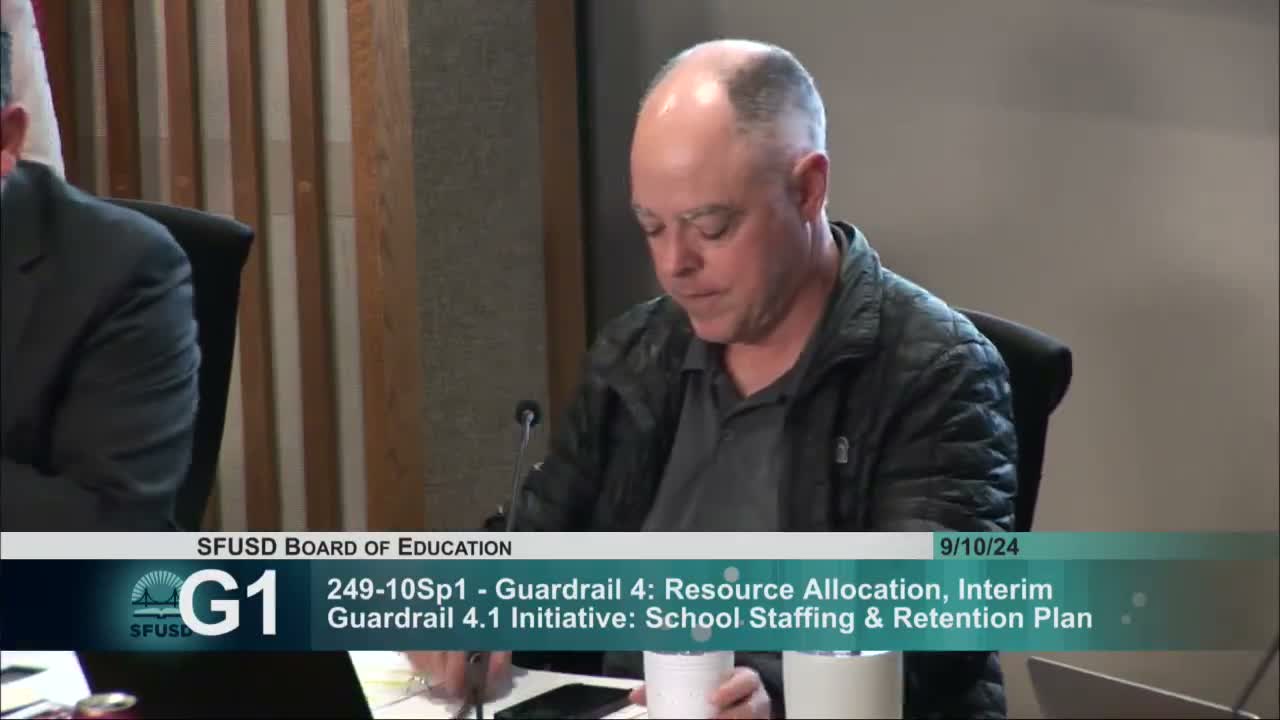
SFUSD staff report missed classroom-staffing target; board accepts HR monitoring report after questions
Loading...
Summary
SFUSD HR reported opening the school year with 82% of classrooms staffed (goal 90%) and 85% by day 7. Staff attributed shortfall to a CDE-directed hiring freeze after a negative certification, position-control problems with Empower SF ERP, interdepartmental silos, and special-education budgeting errors. The board approved the HR monitoring report 5–2.
San Francisco Unified School District human-resources leaders told the Board of Education they failed to meet this year’s interim staffing goal for certificated classroom positions and presented an after-action review the board accepted at the meeting.
"Spoiler alert, we did not make our goal," Associate Superintendent Amy Baer said, reporting that the district opened the school year with 82% of classrooms fully staffed (the board’s goal was 90%) and reached 85% by day seven.
HR and talent-acquisition leaders explained four primary causes: (1) systemic problems in the district’s ERP/position-control processes (Empower SF) that blocked timely data entry and onboarding when payroll was locked; (2) silos and poor coordination between HR, business services and school sites; (3) a May negative certification from the California Department of Education that produced an expanded hiring freeze and required CDE advisor pre-approval for vacancies; and (4) special-education budget submissions that exceeded allocated funds, creating positions without position numbers and preventing HR from authorizing hires.
Deandre Ball, executive director of talent acquisition, told commissioners the district had filled many openings earlier in June (76% filled) but that the pause required by CDE stalled onboarding and caused attrition among candidates. HR highlighted some bright spots: substitute coverage rose sharply (from 58% last year to more than 95% coverage in the third week), 94% of custodial positions were filled by the first day, and the district hired more than 300 day-to-day substitutes after 500 interviews.
Commissioners pressed HR for specifics: Commissioner Fisher requested disaggregated vacancy lists (paraeducators, psychologists, nurses, occupational therapists and social workers), counts of impacted students, and clearer links between goals and strategies. HR said the monitoring report focused on certificated classroom positions but agreed to provide additional data on other roles and the student impact via follow-up data requests.
After extended questioning about systems and cross-department workflows, the board voted to accept the monitoring report for Guardrail 4.1. Roll call recorded two no votes (Commissioners Bogus and Fisher) and five yes votes; the motion passed.
Why it matters: staffing shortfalls affect classroom delivery and services for students, particularly special-education populations. HR told the board it is moving to new HR/ERP tools (Frontline and Red Rover), increasing HR capacity and implementing more centralized hiring practices to avoid repeat disruptions.
What’s next: HR committed to providing the disaggregated vacancy data and to continuing the cross-functional meetings with business services and educational services; the board’s Ad Hoc Committee on Fiscal and Operational Health will continue oversight of position control and hiring-process reforms.