Get Full Government Meeting Transcripts, Videos, & Alerts Forever!
Get email alerts on the Earthquake Response topic
No spam. Unsubscribe anytime.
San Francisco disaster council reviews enhanced earthquake response plan, seeks public comments before Dec. 6 adoption
Summary
City officials presented a comprehensive enhancement to San Francisco’s Emergency Operations Plan focused on catastrophic earthquakes, set a two‑week public comment window and said the council will consider formal adoption at its Dec. 6 meeting.
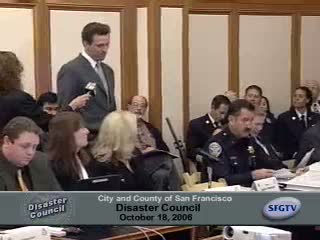
Mayor (unnamed) opened the Disaster Council meeting by flagging a newly drafted earthquake response enhancement to the city’s Emergency Operations Plan and urging council members to review the document and submit comments. The draft adds a focused earthquake annex, a care-and-shelter annex and a tsunami annex to the city’s EOP and is intended to be a living document updated as new lessons are learned.
“This is a very important document for San Francisco,” said Anne Marie, the Office of Emergency Services lead on the project, describing the plan as an action‑oriented enhancement built from internal subject‑matter expertise and external review. The plan’s authors said they consulted URS Corporation and incorporated lessons from Loma Prieta, Northridge and recent events to improve response strategies for the first 72 hours after a major quake.
Rob Dudgeon, who presented the plan’s executive overview, said the draft sets planning assumptions, shortfalls and suggested initial response activities broken out by the first four, eight and 24 hours after an event. He described a revamped Emergency Operations Center (EOC) management model that separates an overall incident commander role from an EOC manager position responsible for internal coordination and state communications.
Dudgeon and Anne Marie asked stakeholders to submit written comments within two weeks so staff can roll revisions into the draft; the council intends to bring the plan back for a formal adoption vote at the Dec. 6 meeting. “We want to hear what you have to say,” Dudgeon said, noting the plan will be adjusted after the Golden Guardian exercise and recent events in Hawaii.
Presenters emphasized that many of the plan’s scenario figures come from regional modeling and federal/state tools such as Hazus and ABAG studies. Dudgeon described a worst‑case 7.9 San Andreas scenario used for planning that projects large numbers of damaged buildings and heavy demands for shelter and medical response; staff reiterated those figures are model outputs used to drive assumptions and resource planning.
Public commenters and council members pressed staff on peer review, interagency inclusion (notably the medical community and hospitals) and specific operational elements such as helipad siting and how the plan will align with regional procedures. Staff said the plan was developed internally and then reviewed by URS to ensure consistency with regional plans.
The council directed staff to collect comments, continue outreach to departments and stakeholders, and return the revised plan for potential certification and adoption at the December meeting.