Get Full Government Meeting Transcripts, Videos, & Alerts Forever!
Get email alerts on the Governance Guardrails topic
No spam. Unsubscribe anytime.
Board debates rewriting 'Guardrail 1' to make public engagement meaningful, not just measurable
Summary
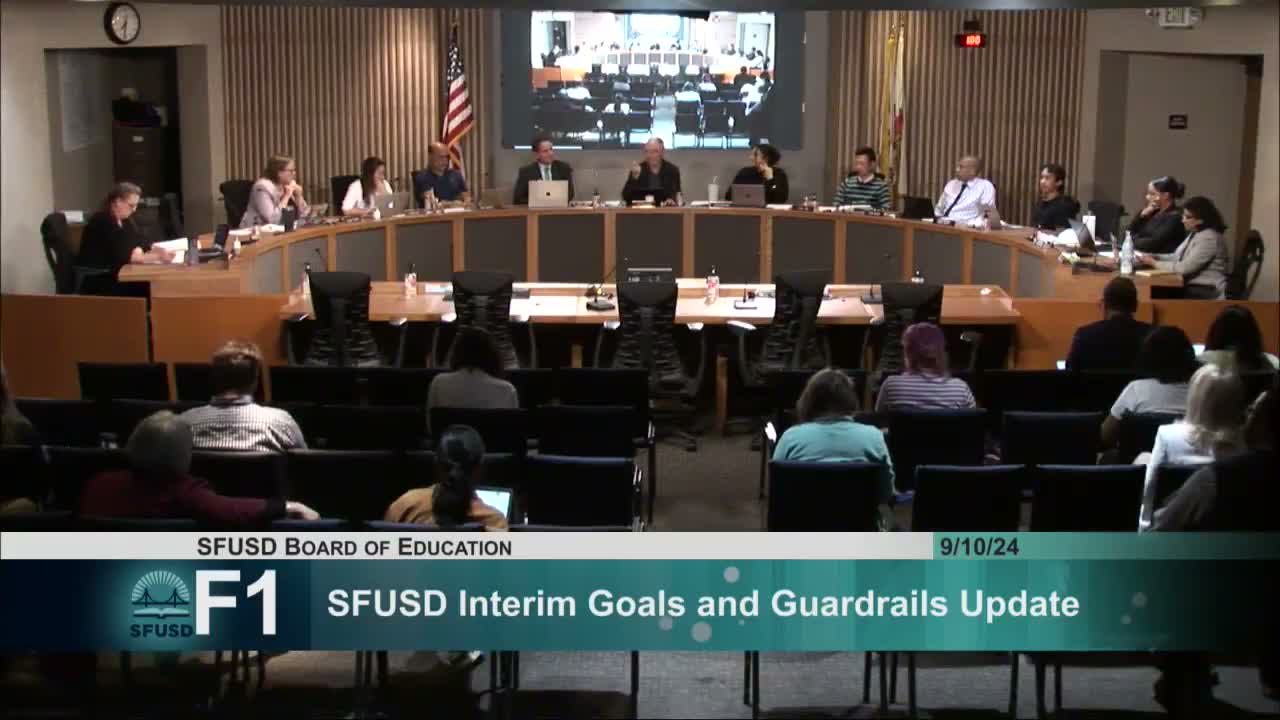
The San Francisco Board of Education spent a large portion of its meeting debating revisions to Guardrail 1 — the policy that requires ‘meaningful consultation’ — with commissioners and community members urging qualitative measures, greater centering of historically marginalized voices, and clearer feedback loops so the public can see how input shaped decisions.
The San Francisco Board of Education spent the evening workshoping revisions to its governance “guardrails,” focusing mainly on Guardrail 1, which directs the district to make major decisions only after meaningful consultation with affected students, families and staff.
“It's not enough to count participation,” Commissioner Evan Fisher said. “We need to demonstrate that the information community members share is actually incorporated.”
Superintendent Matt Wayne told the board the interim metrics were largely set by “backwards mapping” from the board’s 2027 targets; Dr. Ritu Khanna described a rule-of-thumb that grade-level groups received 5% interim growth targets while smaller subgroups received 8% increases. Several board members objected that the interim measures prioritized quantity of engagement over quality and did not show how the feedback was used.
Commissioner Fisher presented slides with draft language and benchmarks drawn from other districts and urged the board to prioritize qualitative measures that capture the depth and influence of community input. Vice President Weisman Ward said the district must “show you how we've incorporated that” feedback or explain why it could not be used.
Commissioners debated process constraints under California’s Brown Act and agreed that a small group of commissioners could draft proposed language for a future meeting; President Alexander said she was open to a proposal and reminded colleagues that any substantive rewrite should be supported by renewed community engagement.
Why it matters: the guardrails are the board’s core accountability tool. Rewriting Guardrail 1 could change how the superintendent measures compliance, how monitoring is done, and how families see their input reflected in decisions about closures, resource allocation and program changes.
What’s next: commissioners who support revision plans to produce a formal draft to return to the full board; the superintendent said he would revise interims if the board adopts a new guardrail. The board did not vote on any changes tonight. The public materials and draft slides the board discussed are posted in BoardDocs under item F1.