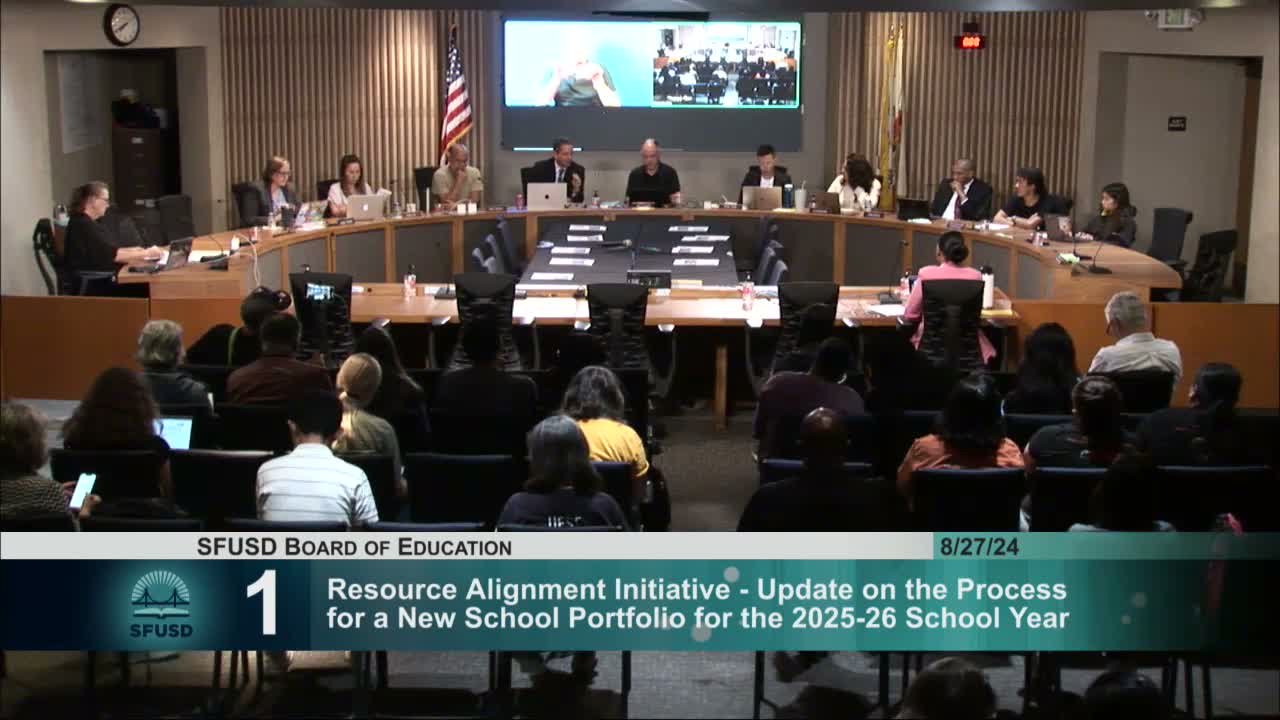
SFUSD outlines plan for a new school portfolio as parents and teachers demand answers on closures, staffing and transparency
Loading...
Summary
At a special San Francisco Unified School District workshop, Superintendent Wayne described the Resource Alignment Initiative process, including a composite score and a Stanford equity audit, while many parents, teachers and community advocates urged more transparency, raised hiring concerns and urged alternatives to school closures.
San Francisco — The San Francisco Unified School District on Tuesday laid out the process it will use to recommend a new school portfolio for 2025–26, saying a proposed list of affected schools will be released Sept. 18 and that the district will follow with community meetings and a phased student-assignment change.
Superintendent Wayne told the Board of Education that the Resource Alignment Initiative (RAI) uses a composite score — weighted by equity, educational excellence and effective use of resources — and that a third-party equity audit from Stanford will help ensure any scenario does not disproportionately affect underserved students. "We are not asking the Board of Education to make any decisions tonight," Wayne said, describing the meeting as an informational workshop.
The announcement did little to calm dozens of parents, teachers and community advocates who filled the public-comment period. Speakers from neighborhood schools and groups including the San Francisco Education Alliance and Coleman Advocates said the RAI has been opaque, rushed and risks destabilizing communities. "No closures, not 1," said a public commenter who urged the board to stop the process and seek alternatives. Several teachers and site leaders said positions budgeted for this fall — social workers, counselors, paraeducators and special‑day-class staff — were hired on paper but blocked in onboarding, leaving classrooms short-staffed.
Board members pressed staff for specifics on how the plan will improve student outcomes, asking for examples of how a student who is behind in reading would be supported after a consolidation. Commissioners repeatedly requested clear metrics, accountable timelines and a detailed transition budget to ensure welcoming placements, transportation feasibility and extra supports such as tutoring and family liaisons. Commissioner Kim asked explicitly whether reorganizing central office operations will translate into better support at school sites; Wayne said an updated organizational chart and some consolidations are intended to yield savings and better alignment.
The district also previewed procedural steps: staff plan to post the recommended portfolio on Sept. 18, hold in‑person school meetings the following day, provide letters and translated communications directly to families and guarantee that students from any closing school will be assigned to a "welcoming school." Enrollment staff said placements will be assigned, with a temporary tiebreaker giving priority to students from closed schools after siblings on the tie‑break list.
Community leaders and several commissioners said the district must show — not only assert — how closures will not produce a ‘‘doom loop’’ of lost enrollment, especially in neighborhoods with long histories of disinvestment. Commissioners asked for a clear transition budget listing capital fixes, staffing, family engagement costs and accountability assignments. The board also scheduled an after‑action review of recent HR and onboarding failures for its Sept. 10 meeting.
What happens next: the district will publish its recommended school portfolio on Sept. 18, hold school‑level meetings and then return to the board with a revised plan in November and action later in the year. Commissioners said they will evaluate the final recommendations against promised equity, staffing and student‑outcome metrics before voting.