Get Full Government Meeting Transcripts, Videos, & Alerts Forever!
Get email alerts on the Public Housing Rad topic
No spam. Unsubscribe anytime.
Mayor's Office outlines RAD conversion for 3,500 public-housing units; City plans $508 million in rehabs
Summary
The Mayor—s Office of Housing told the Building Inspection Commission that about 3,500 public-housing units will convert under HUD—s Rental Assistance Demonstration program in two phases, with rehabilitation estimated at roughly $508 million and local inspections and tenant protections to apply under private ownership.
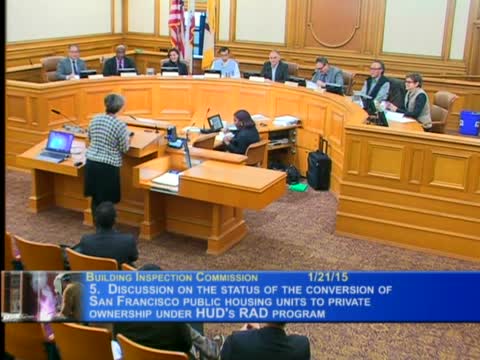
Lydia Ealy of the Mayor's Office of Housing and Community Development told the Building Inspection Commission on Jan. 21 that the city will convert roughly 3,500 Housing Authority units across 29 projects to private ownership under HUD—s Rental Assistance Demonstration (RAD) program, aiming to fund extensive rehabilitation through private debt and tax-credit equity.
Ealy said the conversion will occur in two phases — about 1,400 units beginning this fall and about 2,000 units in mid-2016 — and that the work will be rehabilitation, not new construction. She described the portfolio as aging and in "extreme disrepair," noting previous estimates of $270 million for the whole Housing Authority system and a $508 million estimate for the subset of units moving to RAD.
The mayor—s office said RAD allows preservation of long-term affordability while enabling the leverage of private capital; under the proposed structure the Housing Authority will retain land ownership and lease the building improvements to limited partnerships that include local nonprofit and developer partners. Ealy said the properties will be brought into the same local permitting and inspection framework that governs privately owned affordable housing, and that the required rehabilitations must provide a 20-year useful life under HUD rules.
Commissioners pressed for details about how code enforcement and tenant complaints will be handled after conversion, and asked for a list of the selected developers. Ealy said the projects will be subject to DBI inspections after conversion and that the mayor—s office will provide the list of developers and cluster assignments. She acknowledged concerns where some community-based organizations serve both as tenant advocates and as property managers, saying she would provide the developer list and that tenant protections are included as part of RAD approvals.
Ealy described tenant protections embedded in the program and in developer agreements: "There is no displacement, no rent increase," she said, and added that owners will be required to provide $25 per unit per year for resident activities and organize regular meetings with residents. Commissioners emphasized the need for early coordination between DBI, housing outreach teams and tenant-organizing partners to avoid conflicts, maintain trust and ensure timely complaint resolution.
The commission asked the mayor—s office to deliver the roster of selected developers and to coordinate with DBI on outreach to residents and on inspection staffing needs as the conversion moves forward. The mayor—s office said pre-application meetings have been held and that priority processing and expedited planning review are in place to support the large, parallel scope of projects.
Next steps: mayoral staff will provide the developer list and cluster assignments and continue coordination with DBI on permitting and inspection planning. The commission signaled it intends to schedule follow-up briefings and requested a written report and contact points for resident outreach and complaints.