Get Full Government Meeting Transcripts, Videos, & Alerts Forever!
Get email alerts on the Building Use And Occupancy topic
No spam. Unsubscribe anytime.
San Francisco panel continues appeal over revoked occupancy certificate for Guerrero Street cottage
Summary
The Building Inspection Commission continued to March 18 an appeal by property owner Satish Gupta after DBI revoked a Certificate of Final Completion and Occupancy (CFC) for a rear cottage at 1142A Guerrero St., citing missing permits and records; owner and tenant gave sharply contrasting accounts.
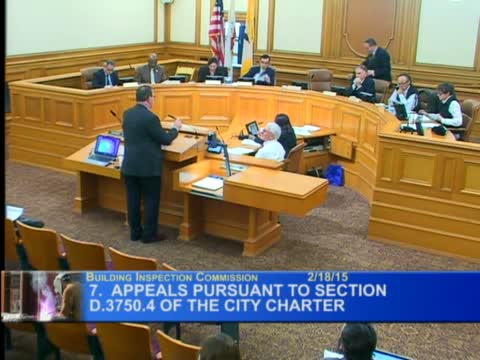
The San Francisco Building Inspection Commission on Feb. 18 moved the contested appeal over the revocation of a Certificate of Final Completion and Occupancy for a small rear building at 1142A Guerrero Street to a March 18 hearing after extended argument from both sides.
The commission heard a detailed presentation from Senior Inspector Patrick O’Riordan, who said a CFC and an over-the-counter permit were issued in June 2014 but that city records do not show a building permit or planning review that would legally document conversion of the rear structure from a storage shed to a dwelling. O’Riordan said earlier permits from 2002–03 were for dry-rot and water-damage repairs and “would not have the credibility” to establish a conversion and that department records thus do not substantiate a lawful single-family use. He cited San Francisco Building Code section 106A.4.5 as authority for suspension or revocation when a permit was issued based on incorrect information.
Attorney Andrew Zacks, representing owners Satish and Neera Gupta, said the owners relied on a city-issued 3R report provided at the time of the property purchase and on prior inspections and that they paid fees toward condo conversion in reliance on that documentation. Zacks told commissioners the owner purchased the property in 2004 “in reliance on the 3R report” and argued the CFC should be reinstated or at least suspended while the parties pursue a planning/legalization path. He also said his client found e-mail communications that had not been produced in response to public-record requests and urged transparency.
The tenant, Daniel Lipsett, who identified himself in public comment as the occupant of the rear cottage, told the commission he had paid rent continuously and that the landlord had stopped accepting rent after the dispute arose. Lipsett said the 2003 permits were over-the-counter alteration permits, not conversion permits, and argued the unit is not lawful without appropriate approvals.
Commissioners split over the legal and policy implications. Several members stressed the importance of the 3R report and reliance interests for buyers and noted the housing shortage and risk of losing units if they are removed from the housing stock. Others emphasized the limits of DBI’s authority to change occupancy without Planning Department approval and voiced concern about setting precedent for approving uses that lacked planning review.
Given questions about whether the department followed ordinary code-enforcement steps and requests from commissioners for additional documents and updated inspections, the commission voted to continue the item to the March 18 meeting. The motion to continue passed 6–1. DBI staff said the department is willing to work with the owner and that a unit-count verification or a planning-process route could be avenues for reinstating occupancy if adequate documentation can be assembled.
Next steps: the commission set a date-certain of March 18 to revisit the matter, and DBI agreed to assist with records and inspections as requested by the commissioners.
(Reporting based solely on the Feb. 18 Commission hearing transcript.)