Get Full Government Meeting Transcripts, Videos, & Alerts Forever!
Get email alerts on the Article 38 topic
No spam. Unsubscribe anytime.
San Francisco health, planning and building officials advance Article 38 proposal but flag implementation hurdles
Summary
The Health Department and DBI presented amendments to Article 38 to require enhanced ventilation (MERV‑13 performance), aligning CEQA and building review; officials praised public‑health goals but raised technical, fire‑safety and Title 24 obstacles and called for clearer implementation guidance for small buildings.
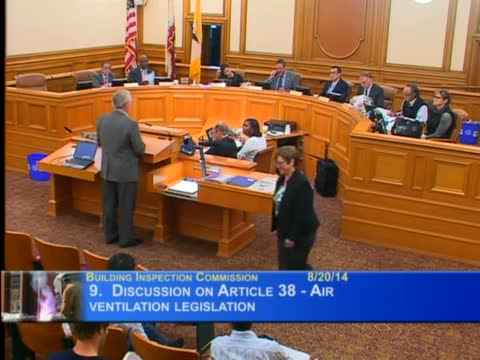
Health and building officials briefed the Building Inspection Commission on proposed amendments to Article 38 that would require enhanced ventilation systems for qualifying residential developments, aiming to codify a MERV‑13 performance standard and coordinate CEQA mitigation with plan review.
The presentation, led by Karen Cohen of the San Francisco Department of Public Health, described how the update would modernize review across Health, Planning and DBI and said the changes already exist as options for developers; codification would standardize performance expectations and could reduce costs in some cases by aligning reviews.
“The goal is to protect indoor air quality,” Cohen said, and staff described examples of designs now being reviewed, from single‑family furnace filters to mid‑rise central systems and novel filter boxes attached to so‑called Z‑duct corridor intakes. Cohen said the department has tested prototypes and is working with mechanical engineers and planning staff to publish guidance and fact sheets for implementers.
But the proposal met sustained technical scrutiny. DBI mechanical-review manager James Zahn and fire‑safety reviewers warned that some approaches — notably proposals that rely on corridor air as the primary outdoor air source for dwelling units — could conflict with building and fire codes governing smoke control and smoke barriers. Zahn explained that openings between corridors and units often require smoke‑control devices and that free air movement could undermine tenable egress in a fire.
Code advisory members and staff also highlighted state rules under Title 24. Several commissioners asked whether San Francisco could adopt a locally less‑stringent exception of the sort used in Seattle; staff and the City Attorney’s Office have preliminarily concluded a local change that is less stringent than state code would be legally problematic without specific local findings. Kirk Means of DBI noted that an exception would require findings based on local geography, geology and climate and that alternate materials and methods remain an available path on a case‑by‑case basis.
Commissioners repeatedly raised implementation concerns for small, low‑rise buildings and remodels. Some members said the policy intent — to reduce respiratory illness linked to poor indoor air — is compelling, but they asked for clear, practical guidance for owners of small buildings and for remedies to avoid imposing disproportionate costs on modest property owners. Staff noted Article 38 traditionally applies to buildings of 10 units or more and that CEQA has already been used to secure mitigation on some projects.
Planning staff added that some mitigation and filtered‑air approaches are already being required under CEQA and that DBI and Public Health are working on sample plans and technical advice to help design professionals and contractors meet the standard. Wade Whitkerff (Planning) said implementation activity is already occurring in areas of high development pressure and that the ordinance’s formal effective date would likely follow additional public hearings (Land Use Committee and full Board) in the fall.
The commission did not vote on the ordinance; staff urged continued stakeholder outreach, technical fact sheets and a loop‑closure with the engineer who proposed the Seattle concept to examine whether an equivalent, code‑compliant solution can be developed for San Francisco.
Next steps: staff said the earliest Land Use Committee hearing could be Sept. 7, with potential Board action in October and implementation early the following year if adopted. Developers, designers and housing advocates will have further opportunities to bring technical designs and cost analyses to staff before final adoption.