Get Full Government Meeting Transcripts, Videos, & Alerts Forever!
Get email alerts on the Sb2113 Replacement Obligation topic
No spam. Unsubscribe anytime.
Commission votes to seek State—s final determination on $1.5 billion replacement‑housing obligation under SB 2113
Summary
The commission authorized staff to petition the California Department of Finance for a final and conclusive determination that SB 2113 established an enforceable replacement‑housing obligation (HCD certified ~6,709 destroyed units; ~5,800 units remain), enabling use of tax increment and debt to replace destroyed housing.
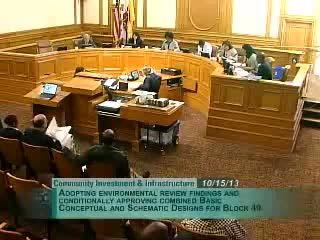
The Commission on Community Investment and Infrastructure voted Oct. 15 to authorize submission of a petition to the California Department of Finance asking for a final and conclusive determination that Senate Bill 2113 established an enforceable replacement‑housing obligation for units destroyed during urban renewal.
Deputy Director Jim Morales summarized the statutory background and the petition process under AB 1484, telling the commission that the agency has previously submitted final and conclusive determination requests for other projects and believes the agency meets the criteria for SB 2113. "We estimate at this point to be approximately $1,500,000,000," Morales said, referring to the revenue required to fulfill the remaining replacement‑housing obligation. Morales recounted that the Department of Housing and Community Development certified 6,709 units that needed replacement; of those, approximately 900 units have been funded and completed, leaving roughly 5,800 units outstanding.
Morales explained that the DOF—s final determination would remove recurring challenges about whether the replacement obligation is an enforceable obligation under dissolution law and would help the successor agency in both funding requests and in legislative efforts to secure authority for continuing tax increment flow where necessary.
Commissioners asked about the source of the tax increment (identified project areas include Yerba Buena Center, Rincon Point/South Beach, Western Addition A2 and Golden Gateway), how replacement units differ from inclusionary or production units, and whether replacement units must be located only within specific project areas. Morales replied that tax increment is limited to redevelopment plans amended before dissolution but that replacement housing can be built anywhere within the jurisdiction of the former agency; he said specific projects would be reviewed on a case‑by‑case basis when funding requests are brought forward.
Public commenters raised historical grievances about redevelopment impacts, questioned the practicality of replacing thousands of units given time and funding constraints, and urged stronger outreach and accountability for residents who lost housing decades earlier.
Chair Johnson moved to authorize submission of the petition to the Department of Finance; the motion was seconded, and the roll call vote was 5 ayes. Staff said they would submit the petition and continue to use the determination in legislative engagement and in evaluating candidate replacement projects.