Get Full Government Meeting Transcripts, Videos, & Alerts Forever!
Get email alerts on the Accessibility SB1186 topic
No spam. Unsubscribe anytime.
DBI, Office of Small Business outline SB 1186 implementation and targeted ADA outreach for small businesses
Summary
Office of Small Business Director Regina Dickendredi told the Building Inspection Commission that state SB 1186 creates a $1 business-registration fee to support CASP inspections and outreach; the city will pilot door-to-door outreach in three corridors and provide brochures in Spanish and Chinese, but funds do not yet pay for CASP inspections.
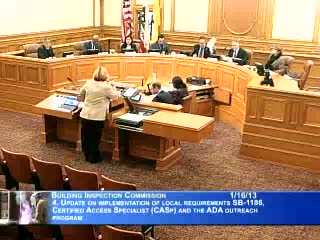
Regina Dickendresi, director of the San Francisco Office of Small Business, told the Building Inspection Commission on Jan. 16 that the state's SB 1186 establishes a $1 collection on business registrations intended to fund Certified Access Specialist (CASP) services, outreach and education for small businesses.
"We roughly have about 80,000 businesses registered in the city," Dickendresi said, estimating that capture of the dollar could yield roughly $52,000 locally. She said the city's initial plan is to target Invest in Neighborhoods corridors in District 4, District 1 along Geary Boulevard and Chinatown and to use Asian Neighborhood Design to lead door-to-door outreach and provide plain-language brochures to business owners.
The presentation emphasized three program components: (1) third-party outreach (door-to-door visits and on-site, nonbinding overviews) to reduce intimidation among small-business owners; (2) local implementation of SB 1186's fee collection and consumer notices on tax-and-treasurer forms; and (3) provisions of Supervisor David Chu's Chapter 38, which requires landlords to disclose prior CASP inspections or compliance status to prospective tenants and to provide a lease-signing brochure.
Dickendresi said the outreach materials are available in Spanish and Chinese and that Asian Neighborhood Design will offer short walkthroughs and low-cost remediation recommendations for readily achievable barriers; higher-level construction needs would be referred to a CASP inspector. She cautioned that current local funds do not yet cover CASP inspections and that the department is still defining program data collection and eligibility criteria.
Commissioners pressed for outreach to non-English-speaking business owners, follow-up reporting and links between ADA work and the city's seismic retrofit program. Commissioner Walker suggested coordinating outreach with seismic retrofit outreach because many ground-floor upgrades overlap with accessibility improvements. Dickendresi said the Office of Small Business will continue coordinating with DBI, Invest in Neighborhoods and neighborhood economic-development non-profits and will report back with program metrics and eligibility criteria.
The commission did not take formal action on the presentation; commissioners asked staff to return with a progress update and suggested a follow-up in roughly two months to review outreach outcomes and data collection plans.
The most immediate next steps are the targeted corridor outreach led by Asian Neighborhood Design, posting the landlord-tenant brochure on DBI's ADA page, and coordination between DBI and the Office of Small Business on criteria for any future funding of CASP inspections.