Get Full Government Meeting Transcripts, Videos, & Alerts Forever!
Get email alerts on the Earthquake Policy topic
No spam. Unsubscribe anytime.
Commission adopts three post‑earthquake administrative bulletins; engineers and staff to refine guidance
Summary
The Building Inspection Commission approved three administrative bulletins (AB 98–100) setting criteria for post‑earthquake repair and retrofit for wood‑frame, concrete and 1–2 family buildings and committed to a year‑long refinement process with engineering stakeholders.
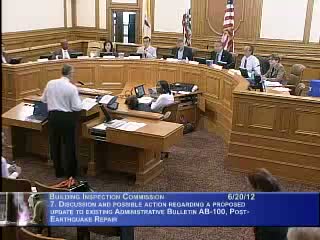
The Building Inspection Commission voted on June 20 to adopt three administrative bulletins that set out criteria for post‑earthquake repair and retrofit for different building types, part of the city’s CAPS Earthquake Safety Implementation Plan.
Lawrence Cornfield of the City Administrator’s office described the bulletins as implementation guidance for damage thresholds in the California Building Code and as an early product of a 30‑year CAPS strategy to reduce earthquake risk. The bulletins address methods for assessing when a building exceeds thresholds that would trigger retrofit requirements and clarify a proposed "disproportionate damage" trigger for a small subset of buildings that show significant damage after even a small quake.
Public commenters including the Structural Engineers Association of Northern California (represented by Kelly Cobine) and DBI staff urged adoption with the caveat that technical refinements continue. "We encourage you to move forward and pass the ABs," Cobine said, offering technical review assistance from structural engineers who would support implementation after an earthquake.
Commissioners noted the urgency: clear post‑quake criteria are important to secure FEMA funding and to speed inspection and recovery work. The commission approved the three bulletins together and instructed staff to continue a year‑long collaborative review with engineers and stakeholders to refine details and implementation procedures for department post‑earthquake inspection protocols.
The bulletins do not in themselves set the department’s operational post‑earthquake inspection assignments, Cornfield said; those implementation steps remain part of DBI’s emergency procedures. The commission emphasized that where external disputes occur about technical evaluations, the department has processes—including bringing in outside firms—to resolve contested determinations.