Get Full Government Meeting Transcripts, Videos, & Alerts Forever!
Get email alerts on the NOV Procedures topic
No spam. Unsubscribe anytime.
DBI outlines NOV workflow, limits to doing emergency repairs and challenges collecting costs
Summary
DBI officials described how complaints are prioritized, NOVs issued and director’s hearings scheduled, and explained why the department rarely performs repairs itself; the city attorney’s office said liens and collection pathways are constrained by state law.
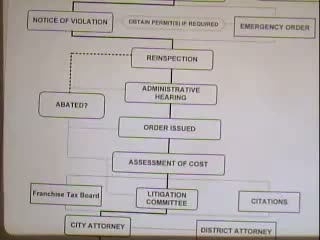
Deputy Director Ed Sweeney gave the commission a step-by-step overview of how complaints move through DBI and the enforcement tools available when property owners fail to comply.
Sweeney said complaints are entered on a standard form, assigned to a senior inspector for prioritization and then routed to district inspectors; complaints that are validated are prioritized by severity. For life-safety issues such as no heat, Sweeney said inspectors typically allow 24 hours for compliance; if the problem is not resolved, DBI issues a second NOV and schedules a director’s hearing (held Thursdays at 9 a.m., Room 2001).
The code allows DBI to order repairs and charge the owner, but Sweeney said in practice the department rarely sends contractors to perform the work because recovering costs is difficult and slow. He cited a Wood Street case where DBI spent approximately $60,000 and recovery is still under legal process. Sweeney said the city maintains an emergency contractor list that DBI can call if necessary.
Commissioners asked about funding for emergency remediation. DBI staff said the repair and demolition fund was depleted for several years but has been partially replenished and currently holds about $300,000 (as stated at the hearing). The department has used that fund for emergencies but cautioned it is not sufficient to fix large-scale deferred-maintenance across the city.
City Attorney staff (John Elmer, John Malmo) explained constraints on collections: many DBI judgments are enforced as judgment liens that are paid only at property sale; some state-law limits apply to pursuing property-tax assessment procedures (tax liens) for certain violations. They said code amendments could enlarge enforcement options (for example by increasing penalties or enabling other collection mechanisms), and offered to work with DBI to present options at a future meeting.
Commissioners asked staff to bring back data on liens, amounts expended, and collections so the commission can assess whether legislative or policy changes are warranted.