Get Full Government Meeting Transcripts, Videos, & Alerts Forever!
Get email alerts on the Illegal Conversion topic
No spam. Unsubscribe anytime.
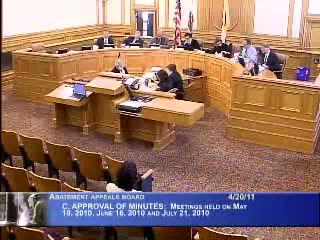
Abatement Appeals Board stays order for 120 days at 557 Howard Street after finding illegal residential conversions
Summary
The San Francisco Abatement Appeals Board unanimously stayed the order of abatement for 120 days for property at 557 Howard Street, citing an active permit filing and ongoing eviction steps; the board upheld assessment of costs and left the 9x investigative fee jurisdictional question unchanged.
SAN FRANCISCO — The San Francisco Abatement Appeals Board on April 20 granted a 120-day stay of an order of abatement for the property at 557 Howard Street, where city inspectors found an unlawful conversion of the second floor into multiple residential units.
Alan Davidson, senior housing inspector with the Department of Building Inspection, told the board the department’s records show a commercial two‑story building with an illegally converted second floor that now houses 12 occupants. The department issued a notice of violation on June 3, 2010, and the director reduced the department’s initial valuation of unpermitted work from $93,000 to $20,000, Davidson said.
The board heard testimony from Alex Fong, the housing inspector who conducted the task force inspection, who described exposed wiring, unapproved partition walls and other safety hazards captured in photographs. "There is an official verbal extension that they already have," Fong said of a prior director‑level accommodation, adding that the director reduced the estimated value "based on the photographs that I presented." Fong said the department would not pursue further enforcement while the owners’ attorneys provided evidence they were pursuing eviction of tenants.
Appellant counsel Bob Nelke, representing the owner, asked the board for roughly 90 days to complete eviction steps and finish permit work. "We have the building permit issued ... We have a notice of termination to the tenants that was just filed ... he's giving a 60 day notice of termination," Nelke said, arguing the reduction from $93,000 to $20,000 required time to research historic permit records.
During public comment Elaine Mollos, who owns the business on the ground floor, described repeated disturbances and property damage she attributes to the upstairs occupants, saying the tenants had "been an ongoing problem for us." Another speaker, Scott Kiper, urged caution in enforcement given the long history of informal residential use in SoMa and recommended allowing time for a peaceful resolution.
Commissioners discussed timelines for tenants to vacate and for completion of permitted work. Commissioner Murphy moved to stay the abatement for 120 days (90 days for tenant removal plus additional time to complete work); the motion specified that if work is not completed by the end of the stay, the abatement order would automatically issue. The board then voted by roll call; President Lee, Vice President Walker and Commissioners Clinch, Hetchanova, Maher, Murphy and Romero all voted "Yes." The motion carried unanimously.
The board also confirmed that, under the San Francisco Building Code as cited by staff, the Abatement Appeals Board lacks jurisdiction to reduce the 9x investigative fee for work without a permit; the board left assessment of costs to be reimbursed under the housing code in place.
The stay means the owner must complete the work required by the director’s order and show compliance within 120 days, or the order will be recorded and enforced. The board’s action leaves intact the director’s reduction of the valuation of unpermitted work to $20,000 and the department’s instruction that the owner must obtain and clear building, plumbing and electrical permits to legalize or revert the second floor use.
The board will not take further action on this case until the 120‑day compliance period expires or the owner returns with a status update.