Get Full Government Meeting Transcripts, Videos, & Alerts Forever!
Get email alerts on the Technology topic
No spam. Unsubscribe anytime.
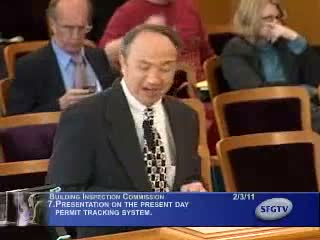
DBI staff demonstrate in‑house permit‑tracking system as city readies RFP for replacement
Summary
DBI presented its existing, in‑house permit‑tracking system and described plans for a replacement: the department reported $5.3M spent to date, an internal increase to $5.8M with additional funding requested and an RFP for professional services; staff emphasized server refresh compatibility and citywide interoperability.
DBI staff demonstrated the department’s existing permit-tracking modules and answered commissioner and public questions as the city prepares to procure a new system.
Hansung Tom, DBI plan check manager, walked the commission through the current in‑house system, showing intake and project screens that record project scope, review stations, special-inspection requirements and permit fee calculations. Tom said the system produces executive and backlog reports and cited a large example project he logged as "$2,121,000,000" to illustrate data capture for major developments. "This tracking system really can tell us how many permits we issue, what type and what revenue we collected," Tom said.
Commissioners and public speakers focused on interoperability, procurement rules and evaluation: Pamela Levin said the RFP under consideration covers professional services while hardware costs are budgeted separately, and she noted the rule that the person who writes an RFP cannot serve on the evaluation committee. Levin said DBI would aim for a citywide solution that allows planning, assessor and other departments to access records without expensive VPN workarounds.
On servers, DBI said it needs a refresh of roughly 47 servers and that the server purchase will be designed to be compatible with whatever permit-tracking option the city selects. Staff described a parallel-run approach: the legacy system and any new system would operate side-by-side during implementation with staged migration of services.
Public commenters and industry representatives urged involving frontline staff and stakeholders in evaluation, exploring modular reuse of functional components of the current system and increasing public access to online tools to reduce in‑person queues.
DBI said the permit‑tracking RFP is active and that an evaluation committee will be formed consistent with city procurement rules. The department will report back to the commission on RFP evaluations and detailed hardware needs as the process proceeds.