Get Full Government Meeting Transcripts, Videos, & Alerts Forever!
Get email alerts on the Special Education topic
No spam. Unsubscribe anytime.
CAC lays out special-education priorities as board reviews new state Learning Continuity plan
Summary
The Community Advisory Council for Special Education presented eight priorities including anti-racism, progress monitoring, and expanded distance-learning supports for students with IEPs. Board and staff discussed accountability and assessment challenges; staff presented the Learning Continuity and Attendance Plan and a phased decision tree for returning students.
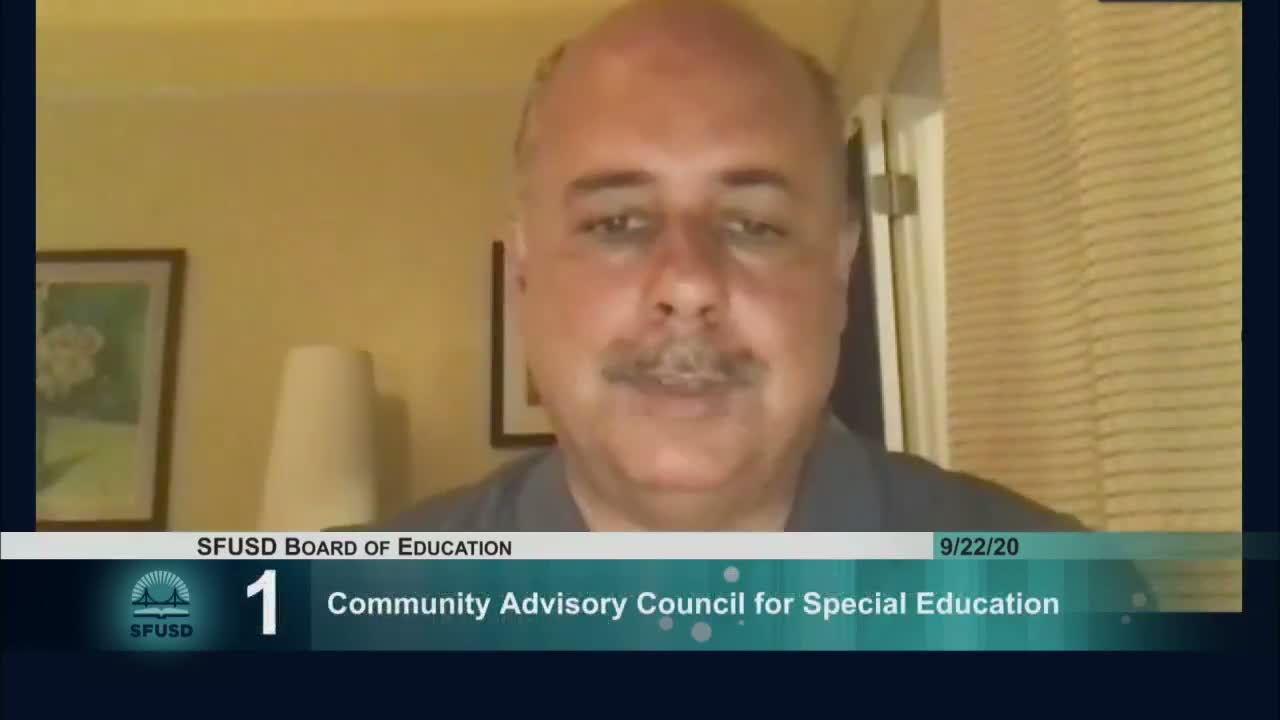
The Community Advisory Council (CAC) for Special Education presented a set of priorities and concrete asks to the board focused on serving students with exceptional needs during the COVID-19 pandemic.
CAC members said the district must address institutional racism and disproportionality in special education, strengthen social-emotional and mental-health supports, expand professional development and distance-learning accommodations, and invest in evidence-based literacy and math interventions. The CAC reported roughly 7,700 students with IEPs (about 12 percent of SFUSD) and noted that 74 percent of students who receive special education services are supported in general education classrooms with resource specialists.
"Our biggest concern is accountability," CAC representatives told the board, urging clear progress-monitoring, transparent reporting and supports for families and site staff. Board members pressed staff on assessment and referral practices during distance learning; staff said a task force has produced recommendations but that some assessment work is still being negotiated with unions and partners.
At the same meeting, Ann Marie Gordon presented the district—s Learning Continuity and Attendance Plan, a one-year document the California Department of Education required this year in place of the typical three-year LCAP. Gordon summarized stakeholder feedback (including joint advisories) and the district—s response, noting two recurring themes: 1) concerns that the compressed timeline limited stakeholder engagement; and 2) a community demand for stronger accountability and monitoring of actions and expenditures.
Board vote and discussion: Commissioners asked for more frequent, public-facing updates and a dashboard showing progress against operational readiness and LCAP milestones. Several members urged staff to provide a transparent tracking tool showing which recommendations are implemented, which are pending, and why those not adopted were deferred.
School reopening planning: Superintendent Doctor Matthews walked through a phased decision tree for small cohort returns and hybrid models tied to county-level public-health indicators and operational checks (PPE, testing plan, trained staff, labor agreements). Board members and public commenters pressed for stronger testing and contact-tracing partnerships and for creative options such as outdoor learning where feasible.
What—s next: Staff will continue engagement with advisory groups, refine assessment plans for students with exceptional needs, and return to the board with progress updates and proposals for making stakeholder feedback and implementation status more visible.