Get Full Government Meeting Transcripts, Videos, & Alerts Forever!
Get email alerts on the Curriculum topic
No spam. Unsubscribe anytime.
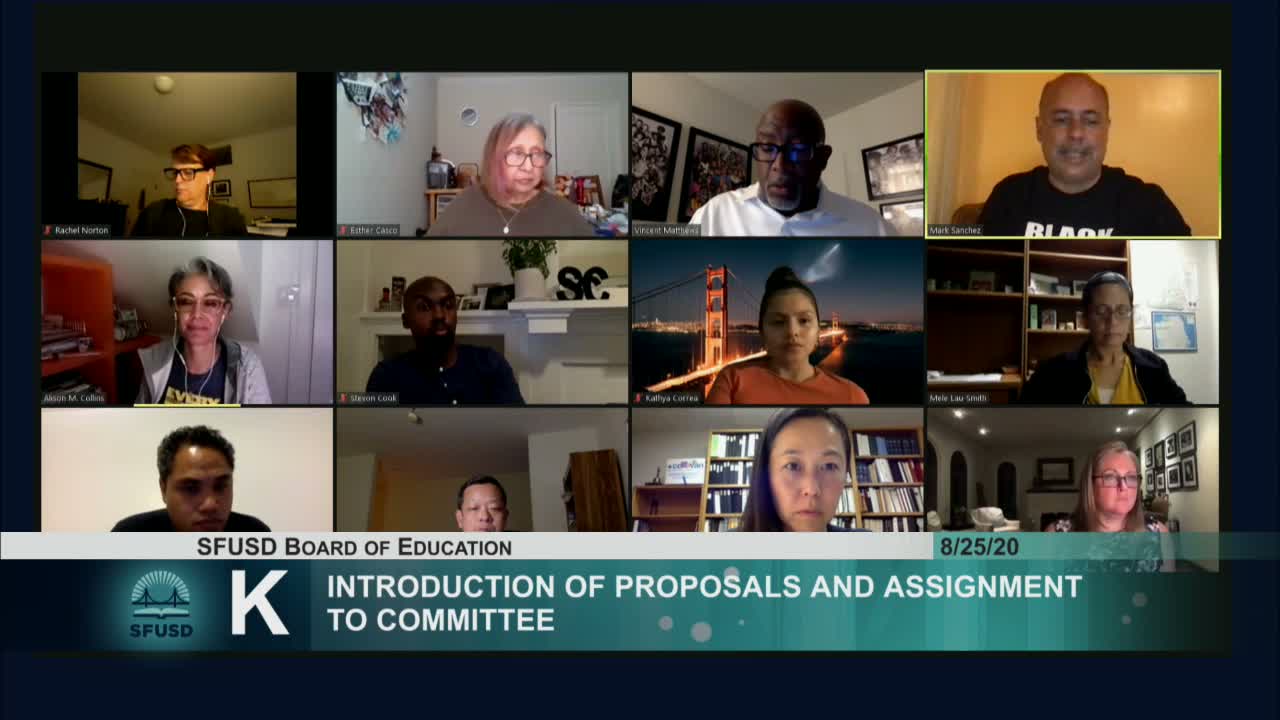
Board hears first reading of K'12 Black studies resolution amid broad community support
Summary
Commissioner Cook introduced a resolution calling for a K'12 Black studies curriculum that honors Black lives and advances Black liberation; dozens of community members, educators, unions and student delegates voiced support during public comment and the item was referred to committee.
The Board received a first reading Tuesday of a resolution introduced by Commissioner Stevon Cook to create a K'12 Black studies curriculum that "honors Black lives, fully represents the contributions of Black people in global society, and advances the ideology of Black liberation for Black scholars in San Francisco Unified School District." The resolution was heard in first reading and referred to committee for further work and implementation planning.
The measure attracted broad public support. Dozens of community advocates, educators and student leaders called in to thank the Board and urge timely action. Speakers included representatives from Mega Black San Francisco, the San Francisco Alliance of Black School Educators, United Educators of San Francisco and student delegates from the district's Student Advisory Council. The public record included requests to ensure the curriculum is taught across subjects (history, science, language arts and others), is developed with community input and provides pathways for advanced study at the high-school level.
Commissioner Cook in his remarks credited community organizations and student leaders and offered the item as a community-driven policy to be refined in committee; several other commissioners volunteered to cosponsor and the Board referred the resolution to Committee of the Whole for next steps.
Why it matters: Advocates said embedding rigorous Black studies across grade levels will address longstanding curriculum gaps, improve student engagement and advance racial equity. University and community partners, unions and student groups offered to support curriculum development and implementation.