Get Full Government Meeting Transcripts, Videos, & Alerts Forever!
Get email alerts on the Distance Learning topic
No spam. Unsubscribe anytime.
SFUSD outlines distance-learning rules, device distribution and attendance plan as fall term begins
Summary
District leaders told the school board that fall instruction will continue remotely with minimum daily minute expectations per SB 98, widespread device and hotspot distribution, and new attendance and outreach procedures; board members and families pressed for clearer communications and support for connectivity and special education needs.
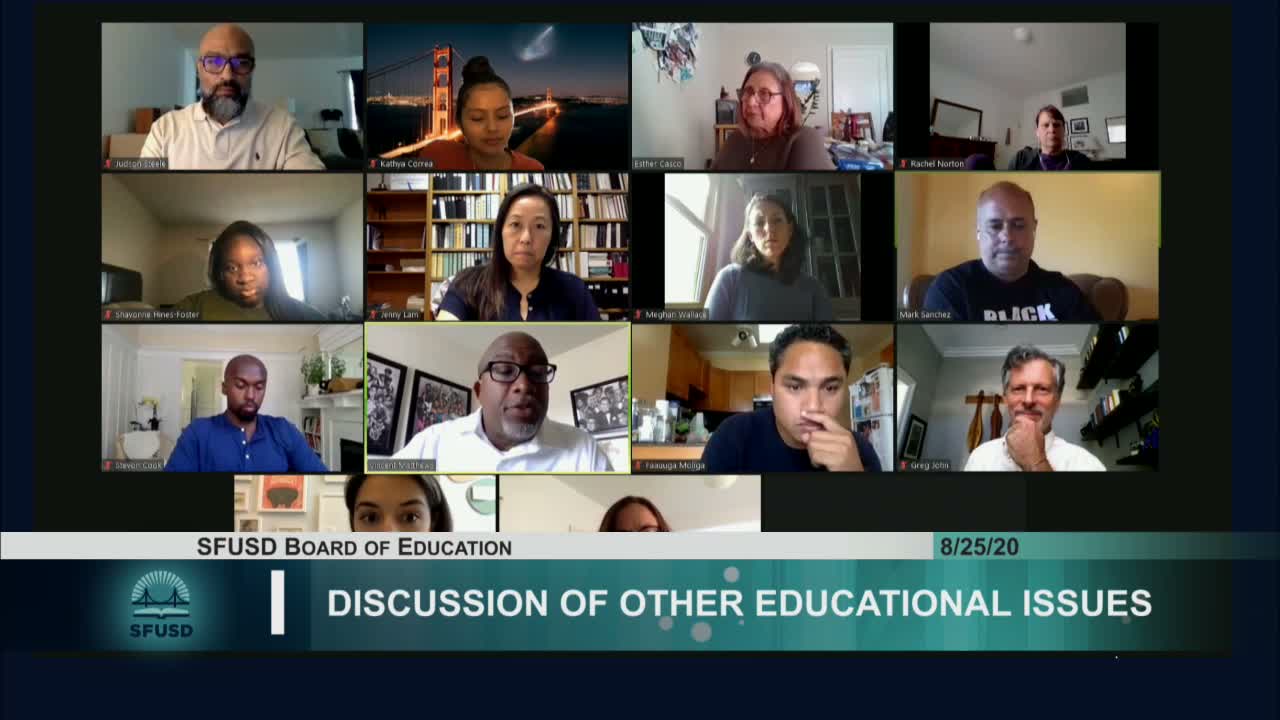
The San Francisco Unified School District on Tuesday laid out a 30-day plan for distance learning, saying the fall term will start remotely while the district builds consistent schedules, multilingual supports and wellness checks.
Deputy Superintendent of Instruction (identified in the meeting transcript as Anikia Ford Martheo / Fort Martell) told the Board that state guidance under Senate Bill 98 sets minimum daily instructional minutes by grade: 120 minutes for prekindergarten, 180 minutes for TK-K, 230 minutes for grades 1'3 and 240 minutes for grades 4'12. The district said those minutes can include synchronous (live) and asynchronous activities and that live interactions can take place by Zoom, Google Hangouts, small groups or phone calls.
The district reported major device and connectivity distributions: over the spring and into the summer it provided about 30,000 student devices and more than 8,600 hotspots; in the most recent device distribution push it reported distributing thousands more (district slides and spoken remarks gave counts for fall distributions). Staff also described expanded professional development (about 80 central-office PDs in August and a ‘‘digital district day’’ with roughly 2,900 participants) and new family-facing supports including 1'1 technology help appointments in multiple languages and a family distance-learning guide on the district website.
Board members and dozens of public commenters pressed staff on operational details. Parents and community leaders asked for: - Clear, easy-to-find instructions and a hotline number for families who do not read English. - Faster, school-by-school reporting on which families still need help registering for ParentVUE or getting devices. - A more explicit, public-facing attendance window so teachers can record late attendance or work-submission-based presence without families being marked absent.
Deputy district staff said 75 percent of SFUSD households now have at least one guardian with an active ParentVUE account; staff are aggregating ParentVUE and platform engagement data to identify families who still need individualized outreach and will distribute school-level reports to principals. They also said they are expanding digital-learning facilitators at school sites to offer family-facing tech support and will continue to refine attendance windows to capture late or asynchronous participation.
Why it matters: The district said consistent structures, attention to equity and a focus on wellness are central to keeping students engaged remotely. Families, unions and board members emphasized that technology distribution alone is insufficient without clearer communications, translation and targeted follow-up for students with the lowest engagement and for families who are not yet connected.
What’s next: Staff said they will return to the Board with more granular attendance and engagement reports in the coming weeks and are developing ongoing PD cycles so teachers can respond to classroom disruptions (including ‘‘Zoom-bombing") without canceling instructional time.