Get Full Government Meeting Transcripts, Videos, & Alerts Forever!
Get email alerts on the Fall Learning topic
No spam. Unsubscribe anytime.
SFUSD staff recommend starting school year in distance learning; board signals agreement
Summary
Superintendent Vince Matthews told the San Francisco Unified School District Board on July 14 that the district will recommend beginning the 2020‑21 school year with distance learning and a phased in‑person return only when public‑health data and logistics (custodial capacity, transportation, PPE, staff MOUs) permit. The board signaled general agreement and asked staff for a detailed plan July 28.
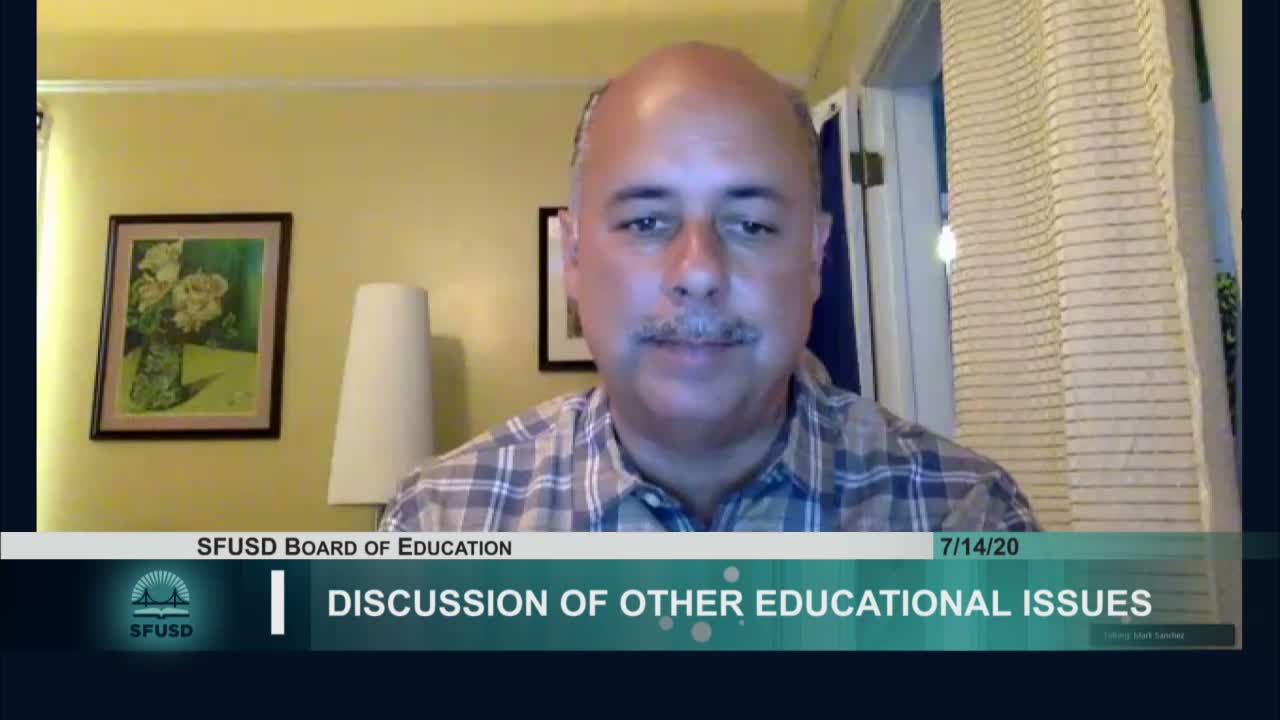
Superintendent Vince Matthews told the San Francisco Unified School District Board of Education on July 14 that the district is leaning toward opening the 2020‑21 school year with distance learning for all students and planning a gradual, data‑driven phased return to campuses.
Matthews framed the recommendation on the city’s public‑health indicators and operational limits his teams documented: hospital system stress, average new daily cases well above the city target, and current San Francisco Department of Public Health orders that do not permit schools to reopen. He cited guidance reviewed by work groups — including the Centers for Disease Control and Prevention, the California Department of Education and AB 77 — and described the district’s process of seven town halls, staff and family surveys and three work groups (teaching and learning, logistics and personnel).
The superintendent described key constraints the district must solve before a full return: custodial and disinfecting capacity (300 custodians cover a fraction of the district’s buildings), reduced transit capacity that could force major increases in routing and buses, and uneven access to devices and high‑speed internet. He said work groups recommended beginning the year with strengthened distance learning, immediate professional development for teachers, device and connectivity distribution, and limited, targeted in‑person supports for the most vulnerable students when safe.
The presentation acknowledged trade‑offs: AB 77 requires minimum instructional minutes and attendance documentation, but the state’s removal of some pandemic waivers also raises operational demands on staff and funding. Matthews urged the community to advocate for broadband affordability and additional resources; staff said the district is pursuing state and federal funding and coordinating with city agencies including the Department of Public Health, Rec and Park and the municipal transit agency.
Public comment was extensive and split: many teachers, parents and community partners supported an initial distance‑learning start combined with strong investments in devices, connectivity, special‑education supports and teacher professional development; others urged prioritizing in‑person options for the youngest learners (TK–2), outdoor learning or small, stable cohorts for students who cannot learn remotely. Several callers raised equity concerns about “micropods” and asked for leave‑of‑absence protections to preserve school placements for families who choose homeschooling this year.
After extended questions from board members about testing, custodial staffing, MOUs with labor groups, device costs and city partnerships, Matthews said the district would announce the board’s direction and return a full, detailed operational plan for approval on July 28. That plan will include timelines for device distribution, proposed MOU elements, attendance and grading protocols for distance learning, and criteria for a phased hybrid return when public‑health conditions allow.
The board’s expression of general agreement with the district direction lets staff tell the community the district is planning to start with distance learning while continuing work with city partners, labor and community‑based organizations on the logistics needed to reopen safely in phases.