Get Full Government Meeting Transcripts, Videos, & Alerts Forever!
Get email alerts on the Policing In Schools topic
No spam. Unsubscribe anytime.
Board hears hundreds urge end to SFPD memorandum of understanding; discussion but no vote
Summary
Hundreds of callers — students, teachers, parents and community groups — urged the San Francisco Board of Education to end its memorandum of understanding with the San Francisco Police Department and remove school resource officers. Staff said edits to the MOU were sent to SFPD in April; the board directed staff to return with options rather than taking immediate action.
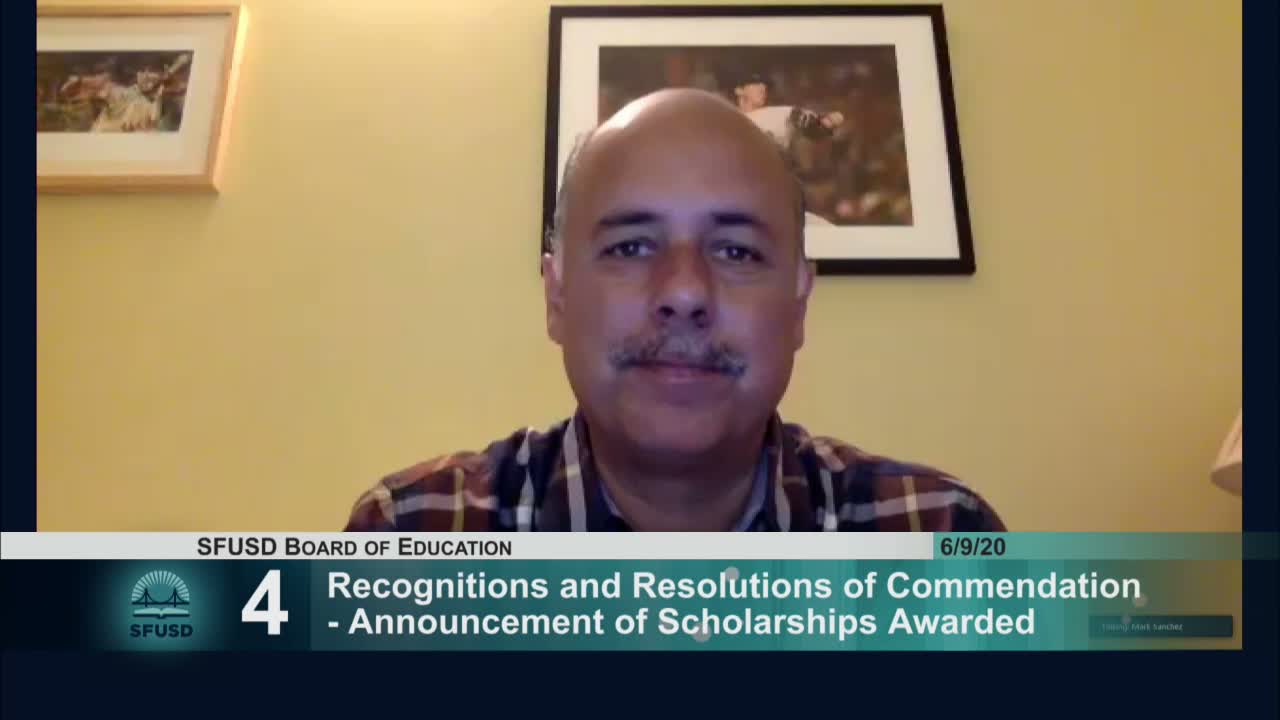
President Mark Sanchez opened the June 9 virtual meeting with a moment of silence for George Floyd and moved a high-interest item — the memorandum of understanding (MOU) between San Francisco Unified School District and the San Francisco Police Department — up in the agenda for early public comment and discussion.
Superintendent Vincent Matthews told the board that the district has been negotiating an updated MOU that “outlines our shared expectations and agreements related to police presence in our schools,” and that district staff have not reached agreement with SFPD. Chief of Student, Family and Community Support Mele Lau Smith said the current draft stems from a community review tied to a 2014 MOU, that edits were finalized and sent to SFPD and the City Attorney’s Office in April, and that the district does not exchange money with SFPD under the MOU. “We have not reached agreement,” Matthews said.
The board then opened an hour-plus of public comment. Dozens of callers — including youth leaders, teachers, public-health researchers, parents and community organizers — urged the district to discontinue the MOU and remove SROs from campuses. “I’m calling to demand that SFUSD discontinue their MOU with SFPD,” said Ted Wechter, identifying himself as a Richmond District resident and union member (public caller). Students and student leaders repeatedly urged the board to take action now; educators and public-health speakers said policing in schools disproportionately harms Black and brown students and urged redirection of resources to counselors, wellness centers and restorative-justice programs.
A number of callers sought budgetary detail or proposed specific alternatives. Several speakers called for reallocating a portion of SFPD funds to the district; one frequent figure cited in callers’ remarks was $45,000, which district staff confirmed is the amount SFUSD currently covers for a liaison role in the SRO program. “We pay 20% of the salary for the school-police liaison — currently that’s $45,000,” Chief Lau Smith told commissioners in response to a question from Commissioner Collins.
Board members responded with a mix of urgency and caution. Several said the symbolic impact of ending ties with the police would be meaningful, while others warned that terminating an MOU without clear alternative supports could leave schools and students without protection in crisis or criminal incidents. Commissioner Jenny Lam and others emphasized that the MOU includes protections — such as requirements to notify parents and contact the public defender when police respond to incidents — and asked how ending the agreement would change on-campus protocols.
Several commissioners pressed staff for a practical exit plan. “We need to have something in place,” Commissioner Collins said, noting principals’ concerns about an abrupt change. Superintendent Matthews and other staff described ongoing work with city agencies on mobile health and coordinated-care options and said staff would return with proposals. The item was informational; the board did not take a formal vote to end or renew the MOU during the meeting.
What’s next: Staff said they would begin drafting an exit strategy and alternative response model and return with concrete proposals and timelines to the board. The board repeatedly invited community leaders, parents and labor partners into the planning process.