Get Full Government Meeting Transcripts, Videos, & Alerts Forever!
Get email alerts on the Building Code Adoption topic
No spam. Unsubscribe anytime.
Building Inspection Commission endorses local amendments to implement 2010 California building codes
Summary
The commission unanimously approved local amendments to integrate the 2010 California Building Code, CalGreen and the California Residential Code into San Francisco’s code and will forward the package to the Board of Supervisors for final action.
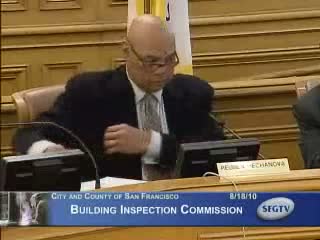
San Francisco’s Building Inspection Commission voted unanimously Aug. 18 to approve local amendments that align the city’s building regulations with the 2010 California Building Code cycle and to forward the amendments to the Board of Supervisors for final action.
Lawrence Cornfield, deputy director of the Department of Building Inspection, told the commission the state issues a new model code every three years and “we are required to use the state code, and we are given the authority to amend it based on local conditions.” The department and its code advisory committees reviewed the new CalGreen (state green building code) and the California Residential Code to identify where San Francisco is more restrictive and where it must adopt state language.
The revisions fold stricter local green‑building provisions into San Francisco’s chapter on environmental concerns and carry forward select provisions from the California Residential Code, Cornfield said. He highlighted one substantive residential requirement carried into the local amendments: the state residential code requires fire sprinklers in new residential buildings in some circumstances, a provision the department has incorporated into the city code where applicable.
Ned Fenny, chair of the code advisory committee, described the subcommittee review process and urged the public and design community to treat CalGreen as “a moving target” because the state and jurisdictions will continue to refine the performance‑based standards.
Public commenters at the meeting broadly supported the city’s green code approach and urged attention to outreach and fairness in implementation. After public comment, Commissioner Walker moved to approve the code package and forward it to the Board of Supervisors; the motion was seconded and passed unanimously on a roll‑call vote.
The commission’s action is procedural: the Board of Supervisors will receive the recommended amendments for its consideration and any additional hearings or votes. The department plans targeted training and updated administrative bulletins to help staff and the building community implement the changes before the state‑level effective date of Jan. 1, 2011.