Get Full Government Meeting Transcripts, Videos, & Alerts Forever!
Get email alerts on the Covid Response topic
No spam. Unsubscribe anytime.
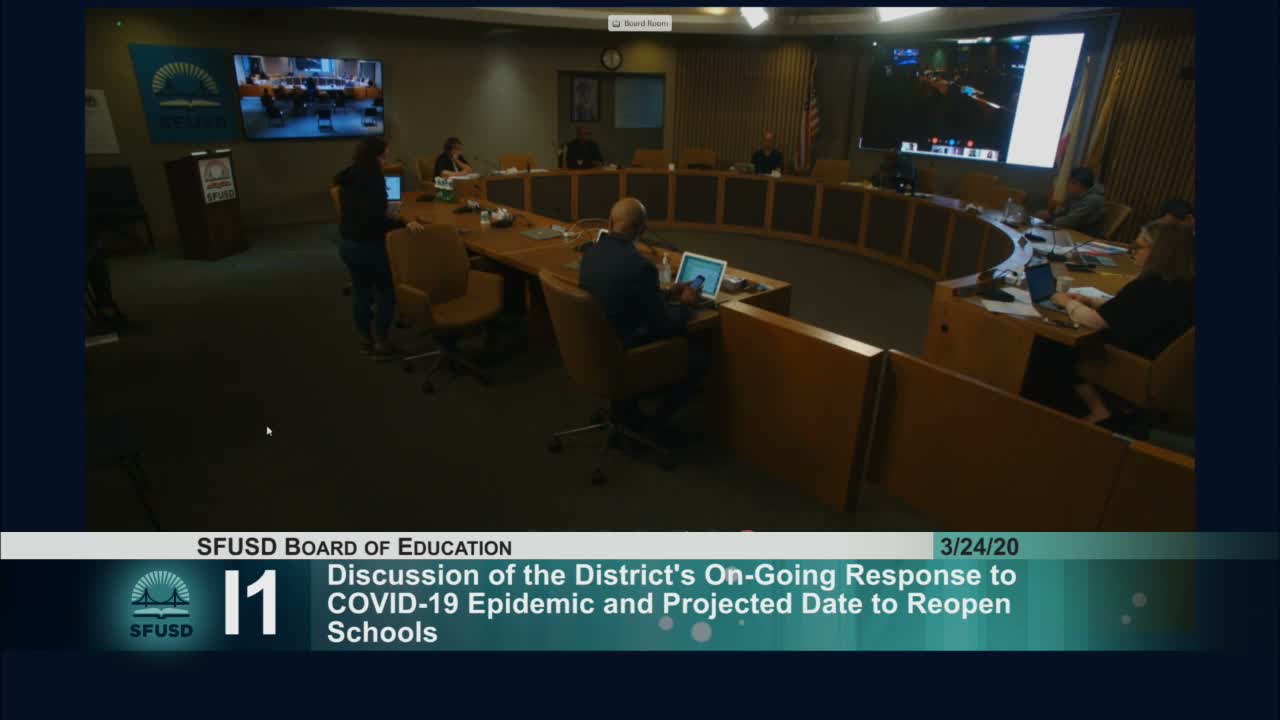
SFUSD board focuses on distance learning, device rollout and food access during COVID-19
Summary
At a remote March 24 meeting, the San Francisco Unified School District Board of Education pressed district leaders for concrete timelines and metrics on Chromebook and hotspot distribution, expanded meal sites, language access and staff pay and sick-leave policies while approving routine business.
The San Francisco Unified School District Board of Education on March 24 asked district leaders for clearer timelines and data as they accelerate remote learning, meal distribution and technology access in response to the COVID-19 pandemic.
Parents and community members who submitted written comments urged faster action. "Get as many students as possible back to formal learning as quickly as possible," parent Matthew Tillman told the board when his comments were read into the record, saying mid-April would be "way too late." Board members then turned to operational briefings from the superintendent and central staff.
Chief Technology Officer Melissa Dodd said the district is using a multi-pronged Chromebook deployment for grades 3 through 12 that includes site-based appointments, centralized pickup and targeted delivery. She said an initial order of about 4,000 Chromebooks was delayed; a second order of 4,000 has been placed, with 500 devices on hand and the balance expected by the end of the week. Dodd said the district is prioritizing high-school and middle-school students, students in specific cohorts, and vulnerable populations such as unhoused students, foster youth and newcomers. She said district schools are feeding data into a centralized master database and dashboard to guide deployment.
On Internet access, the district acknowledged limited hotspot supplies and said it is coordinating with the city's Department of Technology and community partners to identify neighborhood solutions. Dodd advised that the district will request Chromebooks specifically (rather than arbitrary laptop donations) so devices can be managed centrally, and that the district is seeking financial support through Spark SF to replace devices in school inventories.
Superintendent Matthews and Student Nutrition Services executive director Jennifer LaBarr described an evolving meal strategy that has expanded sites and changed menus as participation has grown. The district said it partnered with community-based organizations and the regional food bank; it piloted five food-bank sites last week and planned additional pilots this week. Board members urged the district to post specific site schedules and to use coordinated citywide communications so families without Internet or English fluency can find food and meal sites.
Board members also pressed for language access. The district said urgent safety messages will be custom-translated into six primary languages; regular Monday/Wednesday/Friday digests rely on built-in website translation and ParentVUE language settings. Officials pledged a helpline and multi-language support for tech questions and account activation.
On staffing and pay, district officials said regularly assigned employees—including teachers, paraeducators, noon monitors and central staff—will be paid while working remotely and that supervisors should assign remote duties where possible. The district has published FAQs and a staffing email (staffingquestions@sfusd.edu) to field employee questions. Day-to-day substitutes remain subject to negotiation with unions, and district leaders said they are discussing reopening or augmenting catastrophic sick-leave arrangements with UESF and SEIU in light of COVID-related federal leave provisions.
Board members sought more concrete metrics: how many students lack devices or Internet, where hotspots are deployed, how many food-bank sites will operate and the timeline for expanded services. District staff said they set a Friday deadline to collect school-by-school technology access data and will post dashboards showing percentages of students with device and connectivity access once that data is compiled.
Members also raised public-safety concerns after reports that some families felt intimidated when travelling to distributions. The superintendent said the district is working with the city's emergency operations and police partners on coordinated messaging and additional neighborhood sites to reduce travel and confusion.
The meeting ended with the board directing staff to continue rapid coordination with city agencies, community partners and labor representatives; to post concrete site schedules and technology-access data publicly; and to report back on outreach, equity and deployment timelines.
The public portion of the meeting recessed to closed session to continue confidential business.