Get Full Government Meeting Transcripts, Videos, & Alerts Forever!
Get email alerts on the School Policing topic
No spam. Unsubscribe anytime.
SFUSD and SFPD propose MOU changes after community input; students and advocates call for stronger protections
Summary
District staff presented proposed edits to the SFUSD–SFPD Memorandum of Understanding that clarify when police may be summoned, require dispatch calls rather than direct texting, and add guidance on custody and interviews; community members urged clearer protections for students with disabilities and limits on school‑police interactions.
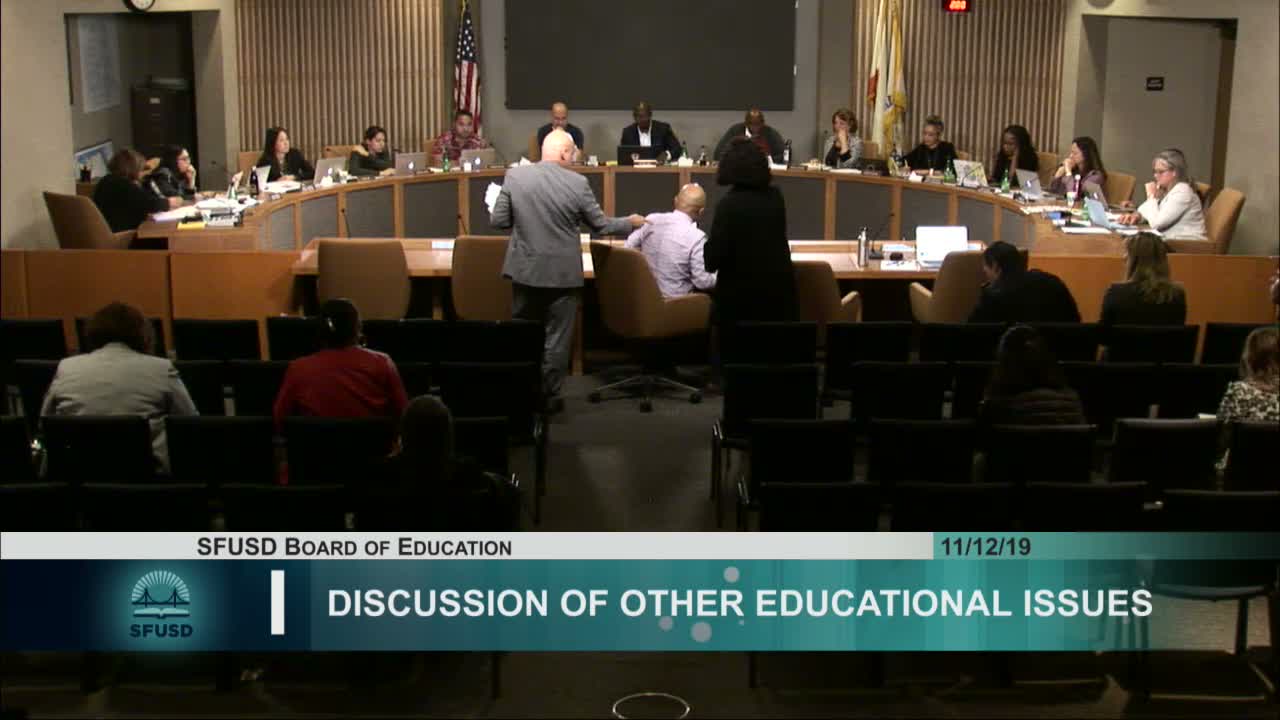
San Francisco Unified School District staff and San Francisco Police Department representatives presented proposed revisions to their Memorandum of Understanding (MOU) on Nov. 12, describing changes intended to limit unnecessary policing on campus and to clarify procedures for officer entry, arrests and student interviews.
Chief Kevin Truitt (Student, Family & Community Support) and Captain Yolanda Williams (SFPD school resource officer liaison) said the draft adds concrete examples for ‘‘exigent circumstances’’ (for instance a firearm on campus, terrorist threat, or violence causing serious bodily injury), encourages the use of police dispatch rather than direct texting to SROs so calls are recorded and prioritized, and asks officers to make arrests away from campus where feasible to minimize public exposure of students.
Truitt also presented arrest statistics the district tracks: year‑to‑year counts were cited in the presentation (examples in the transcript include figures such as 79, 38 and 28 across different reporting periods) and staff said they cannot prove causation but argued clearer district–police procedures may help reduce campus arrests.
In response, students, civil‑rights and disability advocates urged stronger, binding language: they asked for explicit protections for students with IEPs (manifestation determinations and de‑escalation protocols were highlighted), independent accountability when the MOU is violated, and limits on officer presence during staff investigative interviews. Several speakers asked the board to consider removing SROs from schools entirely.
Captain Williams described SRO selection and training protocols, including Crisis Intervention Training (CIT) and de‑escalation instruction, and said SFPD seeks to expand juvenile‑specific training departmentwide. The draft also cites a San Francisco ordinance referenced in the presentation as “96c,” which requires consultation with a public defender for minors (the presentation said the city requires public‑defender consultation for students 17 and under). The district signaled it will take additional community feedback and return a final MOU draft for signature by the superintendent and the police chief.
Board members and staff stressed next steps: continued public input, stronger language around special‑education protections and monitoring for compliance. The MOU will return to the board for a formal vote once staff incorporate feedback and finalize wording.