Get Full Government Meeting Transcripts, Videos, & Alerts Forever!
Get email alerts on the Fee Deferral Ordinance topic
No spam. Unsubscribe anytime.
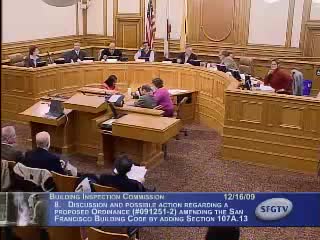
Commission recommends ordinance to centralize and defer impact‑fee collection; 5–1 vote
Summary
The commission voted 5–1 to recommend an ordinance consolidating development impact‑fee collection at DBI and allowing developers to elect to defer payment until just before a first certificate of occupancy, subject to a blended deferral surcharge and monitoring.
The Building Inspection Commission voted 5–1 on Dec. 16 to recommend to the Board of Supervisors an ordinance that would consolidate development impact fee collection in the Department of Building Inspection and provide an elective deferral mechanism for impact fees.
DBI Director Vivian Day introduced the measure and supported the consolidation as a way to provide a single, transparent project development fee report at the time of building or site permit issuance. Michael Yarny of the Mayor’s Office of Economic Development framed the ordinance as part of a package to reduce upfront barriers to construction during the recession: the measure establishes three enforcement 'gates' — (1) a project development fee report before issuance of a building/site permit; (2) full payment or enrollment in a deferral program at the first construction‑ready permit; and (3) payment of deferred fees plus approval of any promised in‑kind public benefits before the first certificate of occupancy.
Under the proposed deferral option a blended surcharge would apply to deferred fees (a rate blending treasurer interest and a local construction‑inflation index), and interest would accrue daily until final payment prior to the first certificate of occupancy. Advocates from the construction trades and design community supported the measure as a stimulus for jobs; some community advisory committees urged caution about cash‑flow timing for neighborhood infrastructure and sought clearer mitigation assurances. Commissioners adopted a motion recommending the ordinance as amended and requested annual review/monitoring of the program by DBI and the commission.
Vote: The motion to recommend the ordinance (as amended) passed on a 5–1 vote; one commissioner opposed. The commission added an expectation that DBI and the commission review the program’s effectiveness and report recommendations to the mayor and Board of Supervisors after implementation.