Get Full Government Meeting Transcripts, Videos, & Alerts Forever!
Get email alerts on the Abatement Case 6725135 topic
No spam. Unsubscribe anytime.
Abatement order for 135 El Camino Del Mar upheld; enforcement and new monitoring fees stayed for one year
Summary
The Abatement Appeals Board upheld DBI’s abatement order for 135 El Camino Del Mar but unanimously voted to delay enforcement and suspend new monthly monitoring fees for one year while the owner pursues planning and permit review; quarterly progress reports were required.
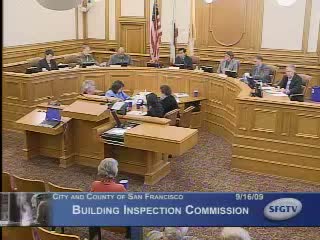
The Abatement Appeals Board on Sept. 16 upheld the Department of Building Inspection’s abatement order relating to 135 El Camino Del Mar but voted unanimously to delay enforcement and suspend new monitoring fees for one year while the property owner pursues permit review. The board also required periodic progress reports during the stay.
Deputy Director Edward Swinney of the Department of Building Inspection told the board that DBI had issued three separate notices of violation after repeated complaints and site inspections showed as-built conditions that did not match approved plans. “My name is Edward Swinney. I’m deputy director of inspection services at DBI,” he said, and described altered plans, microfilm comparisons and a survey indicating encroachment onto an adjoining property.
Counsel for the owners, Andrew Junius of Rubin & Junius, argued the enforcement timeline and process were unfair for a complex site. Junius said the appeal centered on three issues: allegedly duplicative notices of violation, insufficient time to complete work because of planning-review delays, and a disputed rear-property encroachment he described as about eight square feet. “We don’t believe there’s an issue at the back,” Junius said of some parts of the site, while arguing that permits filed in December 2008 were still under planning review and the code processes could take months or years.
Adjacent property owners disagreed. Zelco Simone, who identified himself as an adjacent owner, said his own review found three illegal additions and no permits for recent work: “There are 3 illegal additions done over this property for the last 10 years... There are no permits whatsoever.” Neighbor Bob Scufolo, who lives across the street, told the board the house had “ballooned” since the sinkhole incident and urged consistent enforcement: “All of us have to play by the same rules.”
Commissioners and DBI staff discussed technical questions including whether the 1998 permit set included an accurate survey, the measured two-foot-five-inch extension on the south wall, and whether the soffit and overhang created the encroachment. DBI said it could not issue permits that depict construction crossing property lines. The board also reviewed legal guidance about timeframes in Section 105 of the building code, including different timing for life-safety and non-life-safety findings.
After deliberation the board moved to uphold the abatement order but suspend further enforcement action for up to one year, conditioned on periodic (approximately quarterly) reports by the appellant documenting progress with planning and any private negotiations over the property line. The board clarified that costs already incurred remain billable; what was suspended was the monthly $52 monitoring fee and further monitoring charges for the one-year period. The motion carried in a roll-call vote with all six commissioners present voting in favor.
The board scheduled a progress review in three months. If planning ultimately rejects the pending permit applications or life-safety hazards are found, DBI may resume enforcement and billing per the abatement order.
By the close of the hearing the board had not ordered demolition or immediate removal of the disputed encroachment; instead it established a structured period for the owner to pursue planning review and private settlement while preserving DBI’s right to assess and recover costs later.