Get Full Government Meeting Transcripts, Videos, & Alerts Forever!
Get email alerts on the Education Middle School Redesign topic
No spam. Unsubscribe anytime.
SFUSD details middle grades redesign pilot, aims to expand access to arts, computer science and health
Summary
San Francisco Unified presented a middle grades redesign pilot at Roosevelt and Francisco middle schools focusing on exploratory courses, block scheduling, project-based learning and expanded access to computer science, arts and health. Commissioners pressed staff on scheduling, electives and scaling.
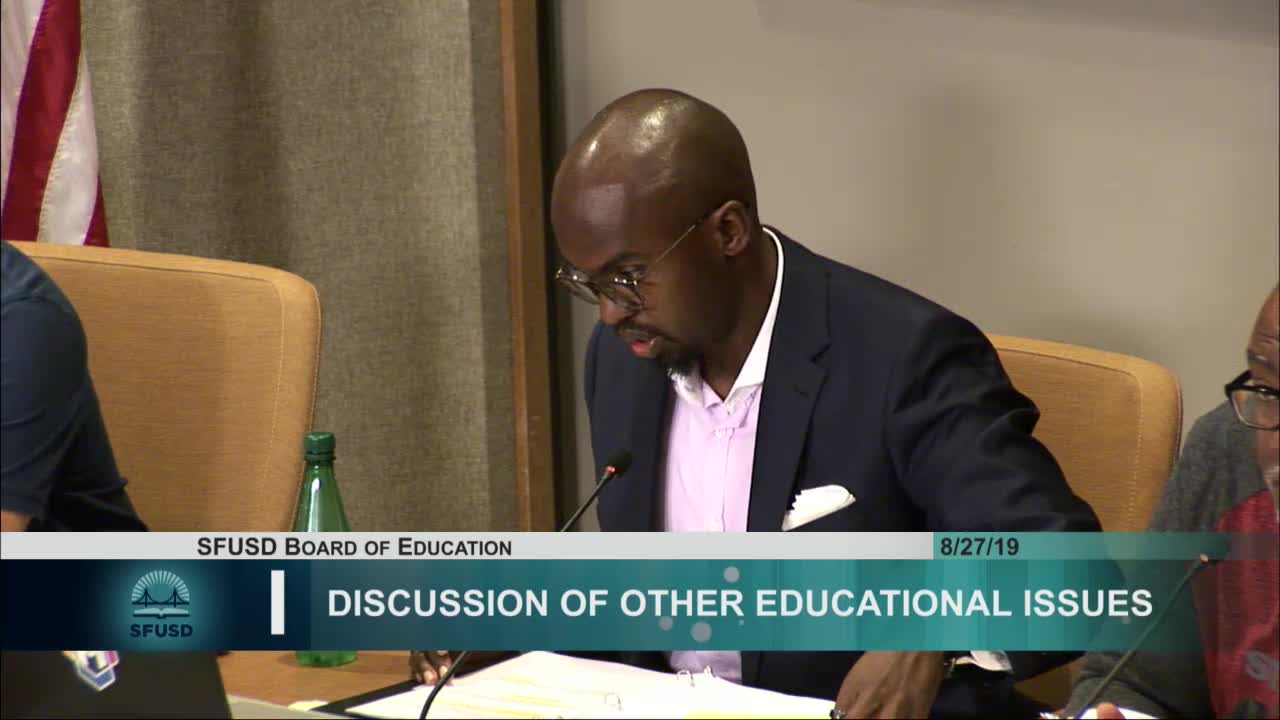
San Francisco Unified School District leaders on Aug. 27 detailed a pilot for middle grades redesign intended to broaden access to arts, computer science, health and world languages and to change daily schedules and adult learning time at pilot sites.
Superintendent Richard Matthews framed the initiative as part of the district—s Vision 2025 goals, telling the board that "our average teacher salary has gone up from 62,000 5 years ago to 82,000 this year" and that computer-science participation has jumped "from 700 students" five years ago to "over 25,000" last year. Staff said the redesign is intended to make similar course access equitable across middle schools.
Assistant Superintendent Miss Hanfa and Acting Chief Academic Officer Jennifer Steiner outlined structural changes: an exploratory "wheel" of trimester (12-week) courses so every sixth-grader samples subjects such as visual and performing arts, computer science and world languages; acceleration courses for targeted literacy or math support; and aligned early-release professional-learning time so teachers can plan collaboratively. Melissa Dodd, chief technology officer, described how pilot schools Roosevelt and Francisco will test modified schedules — Roosevelt adopting a seven-period day with a modified block and Francisco remaining on a six-period schedule while implementing aligned professional learning.
Commissioners pressed staff on operational details. Vice President Sanchez asked which students might be unable to access electives under a seven-period day; staff replied the pilot year will surface constraints and the district is working with its Research, Planning and Assessment Office to measure access and outcomes. Commissioners also asked how exploratory trimesters would prepare students for deeper study; staff said a trimester is intended as a sampler and that electives provide deeper study across later grades. On acceleration courses, Steiner said literacy and math acceleration curricula are in development and that some acceleration offerings this year will focus on students below grade level, with more options planned for the future.
Teachers who have piloted the changes said block scheduling and project-based learning have given them more time for labs, deeper lessons and collaborative planning. Supporters on the board asked staff to provide clearer "menu" information for families listing sample electives and school-by-school offerings as the redesign scales.
District staff said the approach is intentionally iterative: the pilot will allow the district to "go slow to go fast," learn what works in scheduling and instruction, and refine the model before broader rollout. The board was told to expect a more formal update in January and that the district will submit evaluation results and scaling recommendations after the pilot year.
Next steps: the district will continue stakeholder outreach, run a task force with United Educators of San Francisco (UESF) and publish evaluation results from Research, Planning and Assessment to inform scaling decisions.