Get Full Government Meeting Transcripts, Videos, & Alerts Forever!
Get email alerts on the School Meals Revolution Foods topic
No spam. Unsubscribe anytime.
Board declines to renew Revolution Foods contract after heated debate on quality and waste
Summary
After extensive public input and board debate about meal quality, plate waste and vendor options, the SFUSD Board voted down a one‑year renewal of the district’s contract with Revolution Foods on April 23. Staff said a lack of alternative vendors and a multi‑year plan to expand in‑house production shaped their recommendation.
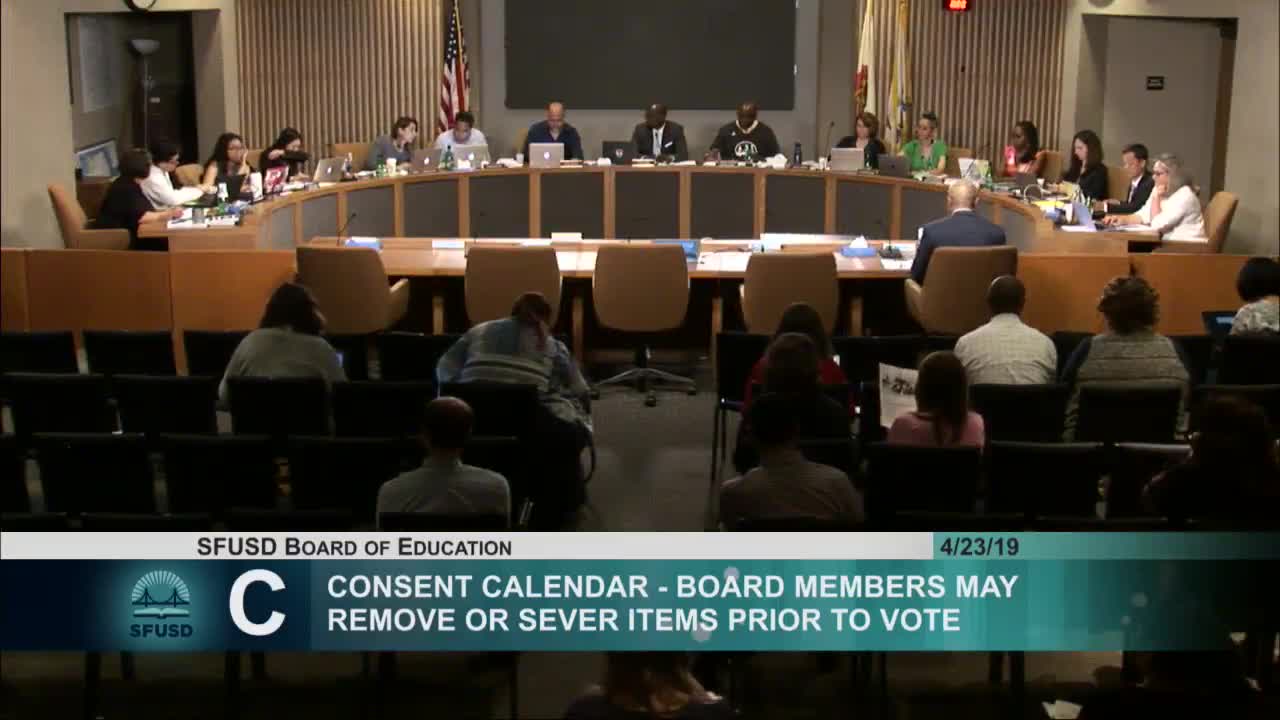
The San Francisco Unified School District Board of Education voted on April 23 not to approve a one‑year renewal of the district’s contract with Revolution Foods after extended public comment and a contentious board discussion about meal quality, food waste and how to replace external vendors at scale.
Executive Director Jennifer LaBarre, who leads Student Nutrition Services, told the board that Student Nutrition has worked with Revolution Foods since January to address complaints about meal quality and has instituted menu, ordering and performance requirements — including contractual performance language and fines — to improve service. LaBarre said plate‑waste studies are underway in partnership with UC Berkeley and that staff is tracking daily waste and adjusting orders accordingly.
Board members were sharply divided. Board President Stefan Cook said the persistent complaints made it hard for him to support renewal: “The complaints that I heard about the quality of the food throughout the city has been pretty alarming…it's hard for me to vote yes.” Several commissioners echoed concerns about waste, inconsistent delivery and equity: they feared that low‑income students who rely on school meals already are disproportionately affected when meals are unpopular.
Others cautioned that rejecting the contract without a credible vendor alternative or sufficient lead time could leave the district without a provider for summer programming and many school days. Ms. O’Keefe and other staff said they had conducted a competitive bid process and found few vendors able to meet SFUSD’s nutrition standards, procurement policy and the scale of roughly 30,000 unitized meals per day. Staff emphasized a multi‑year “plan B” to increase in‑house meal preparation, build a central kitchen at McAteer/Soda, and gradually reduce reliance on outside vendors.
After extended floor discussion and requests for more data (including waste measurements, student/parent survey results and a timeline for in‑house production), the board held a roll‑call vote on the consent calendar item. The votes were recorded as: Yes — Aruino, Mai, Lam, Norton, Sanchez; No — Collins, Lopez, Maliga, Cook. The motion failed.
The board’s decision leaves Student Nutrition Services and the superintendent to pursue the staff’s stated strategy of increasing the district’s own meal production capacity and accelerating reforms while reporting progress to the board in the months ahead. Staff also committed to provide the board with more robust waste and participation data on request.