Get Full Government Meeting Transcripts, Videos, & Alerts Forever!
Get email alerts on the English Learners topic
No spam. Unsubscribe anytime.
SFUSD to fold Bilingual Community Council duties into DELAC; parents press for technology, training and equity
Summary
District staff and parent representatives presented plans to fold the Bilingual Community Council into the District English Learners Advisory Committee (DELAC), recommending stronger professional development, accountability for reclassification under 2019 ELPAC bands, and expanded after-school and technology supports for English learners.
The San Francisco Unified School District moved on recommendations to continue monitoring and supporting English learner programs by integrating the Bilingual Community Council’s (BCC) duties into the District English Learners Advisory Committee (DELAC), district staff told the board on Feb. 26.
Danielle Utley, education integration specialist in the district’s multilingual pathways department, said DELAC will assume reporting, school-site visits and monitoring responsibilities previously carried out by the BCC, which was created under the Lau v. Nichols consent decree and whose specific paragraph of creation terminated on Dec. 31, 2018. "It is an honor and a pleasure to welcome them on board to the District English Learners Advisory Committee," Utley said of incoming BCC members joining DELAC.
Why it matters: DELAC advises the board and staff on programs and services for English learners. Stakeholders said preserving BCC work in DELAC aims to keep English learner parent voice central while clarifying membership and meeting processes.
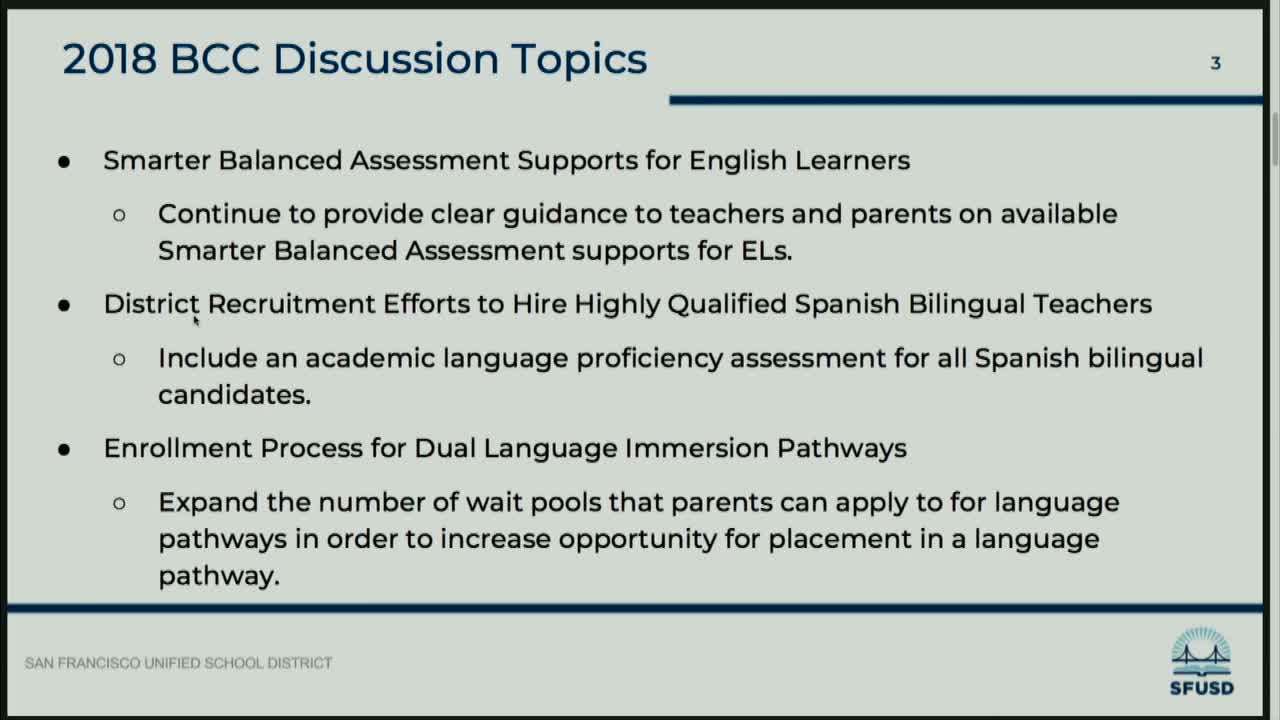
DELAC and BCC members presented three priority recommendations: develop balanced after-school or summer programs that include technology access and keyboarding skills; strengthen district recruitment to hire qualified Spanish‑bilingual teachers; and set an accountability system for professional development and reclassification training tied to the 2019 ELPAC proficiency bands issued by the California Department of Education. "We recommend that the district implement an accountability system with a means to measure and ensure teacher ... reclassification training," DLAC Southwest representative Jeffrey Lee said.
Parents and DELAC co-chairs said data on reclassification rates show disparities that require attention. Marco Ponce, DELAC co-chair, noted different reclassification rates for language groups: "Current data shows that ... Chinese‑speaking English learner students have a reclassification rate of 51% [while] Spanish speaking English learner students ... 28% — a difference of 23%."
Board members pressed for specifics the district can provide: Commissioner Sanchez asked whether district staff have completed any fiscal analysis for a proposed structured summer program; DELAC staff said not yet. Commissioners also asked for data on representation across language groups and for information on how the district will calendar and monitor professional development delivered to school sites.
The DLAC presenters said several implementation steps are already underway — professional development funding exists, they said, but an accountability mechanism to confirm who receives trainings and how often remains a priority. DELAC recommended formalizing small-group formats and subcommittees to support school visits, master plan development and sustained parent engagement.
Next steps: The board agreed to refer curriculum and budget questions for follow-up in committee meetings so DELAC and staff can return with adoption rates, budget impacts and timelines.