Get Full Government Meeting Transcripts, Videos, & Alerts Forever!
Get email alerts on the Special Education topic
No spam. Unsubscribe anytime.
Parents and teachers press SFUSD for special-education fixes, urge creation of case-coordinator role
Summary
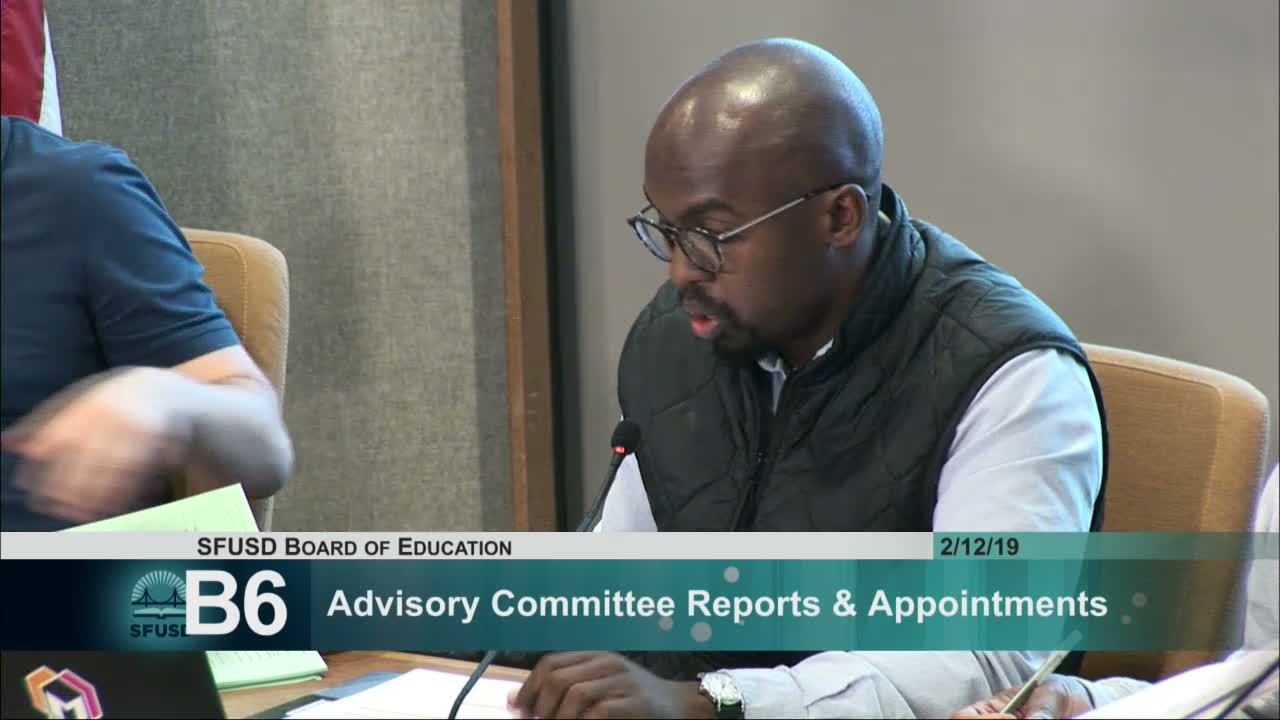
CAC and public commenters urged SFUSD to address special-education compliance and staffing gaps after the CAC reported a rise in special-education graduation rates but persistent implementation problems; teachers and parents asked the board to create a case coordinator to free teachers for classroom time.
The San Francisco Unified School District faced repeated calls Tuesday evening to address staffing and compliance problems in its special-education program, after the districtCommunity Advisory Committee (CAC) laid out priorities and data showing gaps in services.
The CAC told the Board of Education the districtnow identifies special-education students as roughly 12 percent of the student body—about 7,000 students—and reported that the graduation rate for students receiving special-education services rose to 73.5 percent in 2018, up from 66 percent in 2017. The committee nevertheless called for better implementation of interventions, more professional development and a new administrative position to handle back-office work.
"What's gonna happen if [the 800 screened students] are identified for needing further interventions? Are we planning on hiring more staff?" the CAC asked, citing nearly 800 children recently screened for possible intervention needs.
Teachers and parents at public comment urged the board to create a district-level case coordinator to take administrative tasks off special-education teachers so staff can spend more time in classrooms. "This position will assist not only our special-ed teachers, but it will assist the special-education departments in ensuring that schools operate in compliance with all state and federal regulations," said Steven O'Reilly, a district special-education resource teacher.
Will Patterson, co-chair of the districtSpecial Education Committee, described widespread paperwork and scheduling problems: "We have hundreds of unsigned IEPs, thousands of missing progress reports, dozens, hundreds of late meetings," he said, urging the board to fund support that would reduce teacher burnout and save money on settlements.
At the same time, community advocates raised concerns about the districtresponse to dyslexia guidance from the state. "SFUSD is using Fountas & Pinnell's LLI as a primary Tier 2 interventionLLI is not structured literacy," said Megan Potente, a volunteer with Decoding Dyslexia California, arguing that the districttiered intervention mix does not align with the California Dyslexia Guidelines released in 2017.
Superintendent Vincent Matthews and staff fielded questions and pledged follow-up. Matthews said caseload-based FTE allocations are the current mechanism for staffing and that the district will return with details on what a case-coordinator role might look like and the associated costs. "That is something that we can get more information on and get that information back," Matthews said.
Board members pressed for clearer implementation and oversight, including integrating measures into the districtbalanced scorecard so schools' Tiered Fidelity Inventory and supports are visible at the school- and district-level. The CAC and multiple speakers urged the use of school-site and community-based strategies and stronger professional development to ensure fidelity to evidence-based approaches.
The board did not take an immediate vote on new positions; members asked staff to report back with options that include costs, scope and sites where a coordinator might be piloted.