Get Full Government Meeting Transcripts, Videos, & Alerts Forever!
Get email alerts on the Special Education topic
No spam. Unsubscribe anytime.
CAC urges stronger reading interventions and mandatory teacher training; parents and union back calls
Summary
The San Francisco Unified School District Community Advisory Committee on Special Education urged the Board to expand reading interventions and require inclusive-practices training for all classroom staff, citing district data and a public-records comparison showing projected cuts to paraeducators and FTEs. Parents and union leaders testified in support.
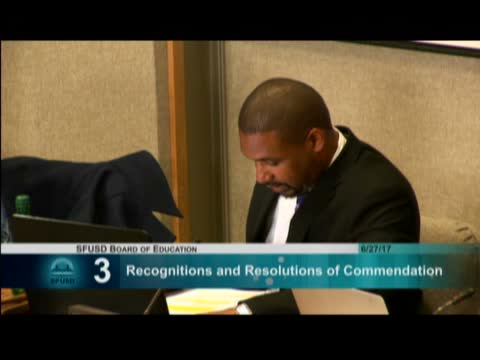
The Community Advisory Committee (CAC) for Special Education presented a detailed report to the San Francisco Unified School District Board of Education on June 27, urging accelerated reading interventions and mandatory inclusive-practices training for general‑education teachers working with students who have Individualized Education Programs (IEPs).
CAC outgoing chair Katie Russell told the board the CAC must sign off on the local special-education plan and budget before it goes to the California Department of Education and highlighted the district’s placement as a single‑district SELPA. CAC speakers cited research including the Annie E. Casey Foundation and an Urban Collaborative report to argue early reading proficiency is a critical predictor of on‑time graduation.
Lee Fisher, speaking for the CAC, and other committee members said interventions beyond elementary school are scarce and recommended expanded Tier‑3 interventions and rollout of the Wilson reading program. Fisher referenced a CAC public‑records request comparing 2016–17 to projected 2017–18 staffing that, according to the CAC, shows approximately 39 fewer full‑time equivalents and 134 fewer paraprofessionals, a gap CAC members said would shift special‑education supports onto general‑education teachers without commensurate training.
Parents and community members gave public testimony in support. Peter Lorentzen, a UC Berkeley professor and parent, recounted a successful inclusion experience for his son and warned that reduced paraprofessional support would harm both students with disabilities and their classmates. Jeff Ubersax and other speakers urged the board to mandate co‑teaching models and sustained professional development, citing New York City’s NEST co‑teaching program as an example.
United Educators of San Francisco representative Susan Solomon also urged the board to mentor and support first‑year teachers — particularly teachers of color — to address recruitment and retention amid a statewide teacher shortage.
Board members asked staff for follow‑ups: Vice President Mendoza‑McDonald requested an update on district implementation of AB 1369 (reading interventions) and Commissioner Norton asked Special Education staff about the specific social‑skills curricula the district uses. Staff identified multiple programs in use, including Second Step district‑wide and program‑specific curricula (Boys Town/SOAR and others) for specialized settings. Staff said some paraprofessionals now receive up to two days of onboarding training and outlined plans to expand professional learning on inclusive practices and restorative strategies.
The committee and speakers framed the request as both instructional (reading interventions and social‑skills instruction) and operational (staffing levels and training requirements). The CAC asked the board to continue building partnerships and monitoring implementation so that inclusion is supported by both funding and measurable staff development.