Get Full Government Meeting Transcripts, Videos, & Alerts Forever!
Get email alerts on the Discipline Attendance topic
No spam. Unsubscribe anytime.
SFUSD presents mid-year review of Safe and Supportive Schools: African American chronic absenteeism remains high
Summary
Chief Kevin Truitt presented mid-year data showing districtwide chronic absenteeism at 11% and 29% among African American students; the presentation highlighted training numbers, heat maps of school performance and an Attendance Work Group plan due in spring 2019.
San Francisco Unified School District staff presented a mid-year report on the Safe and Supportive Schools resolution on Jan. 15, detailing training, discipline and attendance trends and identifying bright-spot schools.
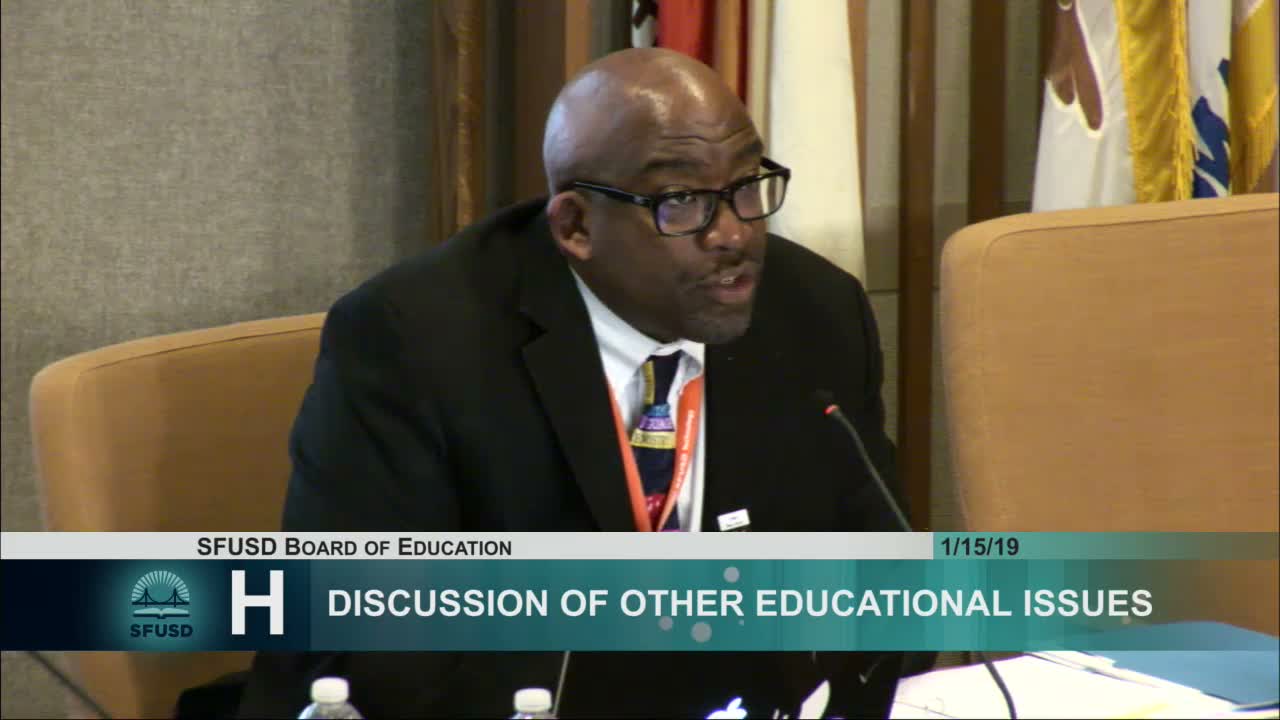
Kevin Truitt, chief of the Student, Family and Community Support department, summarized district efforts including professional development and coaching, and the use of the Tiered Fidelity Inventory (TFI) to assess implementation fidelity at school sites. Truitt said 141 staff had been trained in restorative practices since August 2018 and 462 staff received safety-care/de-escalation training in the same period; the district reported plans for 10 and 22 additional sessions respectively.
On attendance, Truitt said the districtwide chronic absenteeism rate for fall was about 11% compared with 9% in the prior two falls. He said African American students were chronically absent at a much higher rate — 29% districtwide — and cited disparities across school levels that prompted targeted work. "As a district, 11 percent of our students district wide are chronically absent, compared to 9 percent the last fall," he said, adding that "of all African American students, 29% district wide are chronically absent."
Truitt also presented data on office discipline referrals and suspensions, noting middle schools had a sharp rise in referrals but not in suspensions, and high schools showed decreases in referrals and suspensions for most groups. He described heat maps that let administrators compare schools and highlighted elementary and secondary "bright spots" (John Muir, Brett Hart, Marina, Denman, Wallenberg and Washington) and the practices that contributed to improvements.
The report highlighted foster-youth indicators (noting both high rates and some improvements), and announced that an Attendance Work Group of about 30 staff, parent advisory members and site administrators would produce a districtwide attendance plan for presentation to the superintendent and board in spring 2019 for implementation next school year.
Public commenters and union leaders praised the trainings but pressed for broader, site-level implementation and more transparent, school-by-school reporting of TFI and training counts. Commissioners asked for site-level TFI data and clearer splits between routine spring transfers and safety transfers; the district said it can report both while keeping them distinct. The board tabled a separate calendar item related to negotiated work days and said it would brief the board in closed session before any bargaining direction.